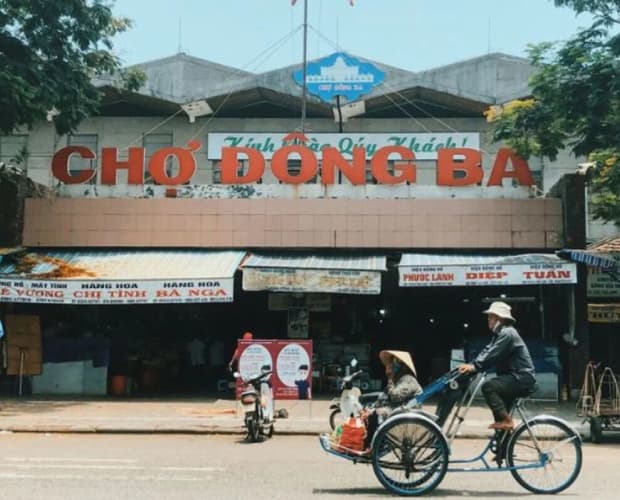
One Week in Vietnam: Three 7-Day Routes
Vietnam ItinerariesBy Pham Phuong Anh
Seven days is enough for one region of Vietnam done properly, not all three. This guide sets out three realistic one-week routes, north, central and south, with day-by-day plans, real tour pickup and return times, the best months for each, and an honest note on what every route leaves out.

Table of contents
One Week in Vietnam: The Short Answer
With seven days, choose one region and do it properly. Vietnam is long and narrow, its three regions are a flight apart, and every extra flight takes a real bite out of a short trip. Each of the three routes below stays in one region, needs no domestic flight between its stops, and gives you a workable seven-day plan, though some days involve early starts or long transfers.
- Route 1, the north: Hanoi, a night on Ha Long Bay and the limestone valleys of Ninh Binh. Choose it for a first visit, for big scenery, and for cooler months.
- Route 2, central Vietnam: Hue, the Hai Van Pass, Hoi An and Da Nang. Choose it for imperial history, an old trading town and beaches.
- Route 3, the south: Ho Chi Minh City, the Cu Chi Tunnels and a night in the Mekong Delta. Choose it for city energy, war history, river life and winter sunshine.
If you would rather sample two regions, there is a section on that further down, with an honest count of what it costs you in time.
Is One Week Enough for Vietnam?
One week is enough to know one part of Vietnam well. It is not enough to cover the whole country at a pace you will enjoy. Seven days usually means six nights, and your arrival and departure days are partly lost to airports.
The distances explain why. Vietnam Airlines gives an average flight time of about 1 hour 20 to 1 hour 35 minutes between Hanoi and Da Nang, and a little over two hours between Hanoi and Ho Chi Minh City. Those are short flights, but each one also needs a transfer to the airport, check-in, and a transfer at the other end. In practice a flight day gives you half a day of sightseeing at most.
A north-to-south trip that takes in Hanoi, Ha Long Bay, Hue, Hoi An and Ho Chi Minh City needs two of those flights and overnight stays in five different places. That works well over a fortnight, and our two-week north-to-south itinerary shows how. Squeezed into seven days, it leaves you with one hurried day in each place.
So this guide does the opposite. It gives each region a full week and tells you plainly what you give up by choosing it.
Three 7-Day Routes at a Glance
| Route 1: North | Route 2: Central | Route 3: South | |
|---|---|---|---|
| Stops | Hanoi, Ha Long Bay, Ninh Binh | Hue, Hai Van Pass, Hoi An, Da Nang | Ho Chi Minh City, Cu Chi, Mekong Delta |
| Fly in / fly out | Hanoi / Hanoi | Hue / Da Nang | Ho Chi Minh City / Ho Chi Minh City |
| Where you sleep | Hanoi, one night on a cruise, one night in Tam Coc | Three nights in Hue, three in Hoi An | Ho Chi Minh City, one night in Can Tho |
| Domestic flights between stops | None | None | None |
| Best for | First visits, scenery, food | History, old towns, beaches | City life, war history, river culture |
| Generally drier months | Autumn to spring | Late winter to summer | December to April |
| What you miss | Hoi An, Hue and the south | Hanoi, Ha Long Bay and the south | Ha Long Bay, Hoi An and the north |
The season line is a rough guide only. Weather in Vietnam differs sharply by region, and our month-by-month guide to the best time to visit Vietnam has the detail.
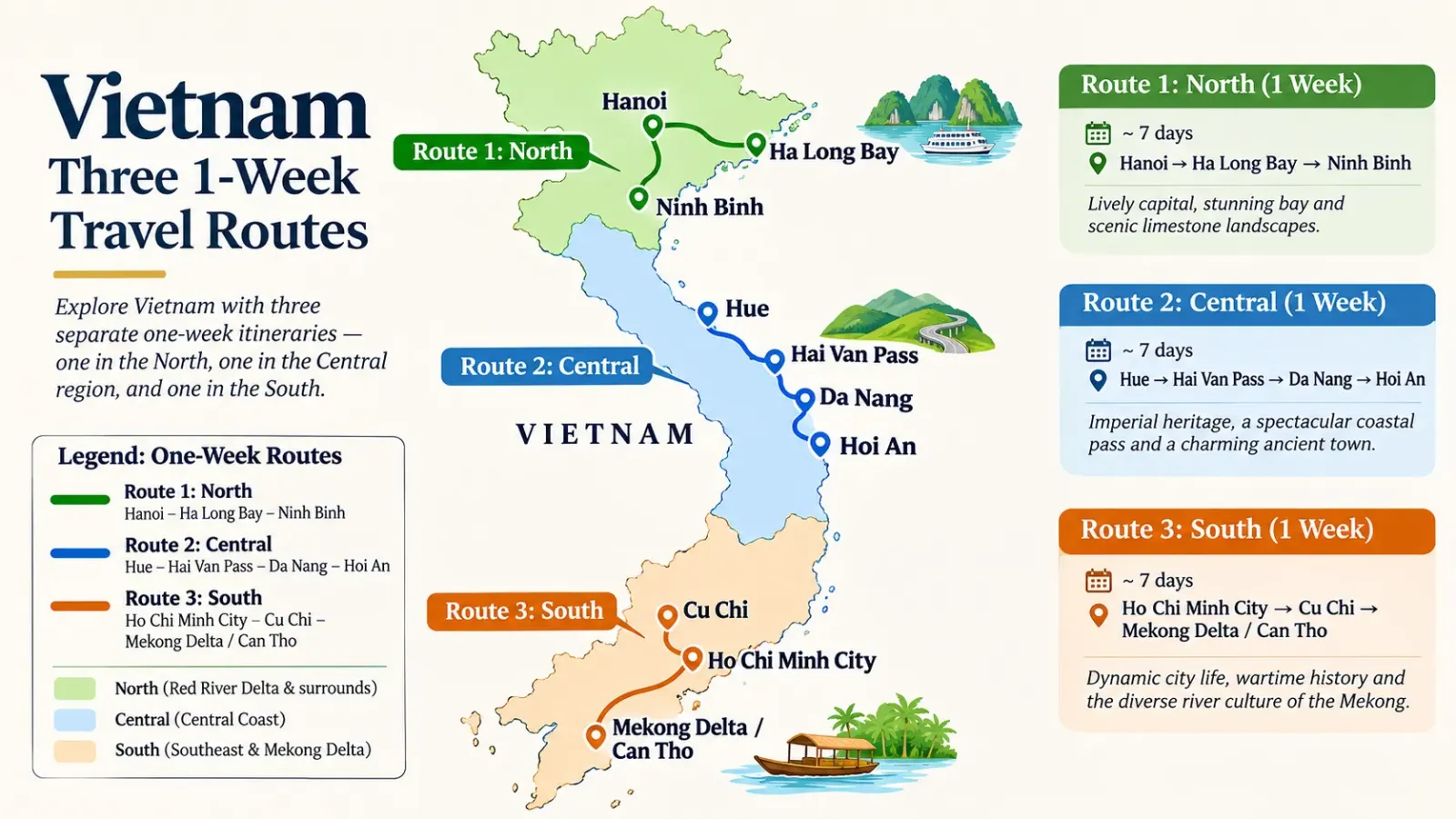
Each route stays inside one region, so none of them needs a domestic flight between its stops.
Route 1: The North (Hanoi, Ha Long Bay and Ninh Binh)
This is the route most first-time visitors picture when they think of Vietnam: a busy old capital, limestone islands rising out of the sea, and rivers winding between rice fields and cliffs. Everything starts and ends in Hanoi, so you book one return flight and never repack for an airport in between.
| Day | Sleep in | Plan |
|---|---|---|
| 1 | Hanoi | Arrive, Old Quarter and Hoan Kiem Lake on foot |
| 2 | Hanoi | Temples, museums and the Ho Chi Minh Complex |
| 3 | Ha Long Bay (on board) | Overnight cruise: cave, island viewpoint, sunset |
| 4 | Hanoi | Morning on the bay, road transfer back to Hanoi |
| 5 | Tam Coc | Ninh Binh: Hoa Lu, Mua Cave, Tam Coc boat trip |
| 6 | Hanoi | Bai Dinh Pagoda and Trang An, return to Hanoi in the evening |
| 7 | — | Last morning in Hanoi, departure |
Days 1–2: Hanoi
Keep the arrival day light. Check in near the Old Quarter, walk around Hoan Kiem Lake, and eat early. Jet lag is easier to handle on foot than on a tour bus.
Day 2 is for the capital's main sights, which are spread too widely to walk between. The Hanoi Cultural Heritage Full-Day Tour covers Tran Quoc Pagoda, the Ho Chi Minh Complex, the One Pillar Pagoda, the Temple of Literature and the Museum of Ethnology in one day. On Mondays, the program lists the Vietnamese Women's Museum instead of the Museum of Ethnology. The Ho Chi Minh Mausoleum is viewed from outside on this tour. Hotel pickup is listed at 07:30–08:00 and the return at about 16:00–16:30, which leaves the evening free for street food or a water puppet show.
If you want to plan these two days in more detail, including what to do with a third day in the city, see our 3 days in Hanoi itinerary.
Days 3–4: Ha Long Bay overnight
With a full week in the north, take the overnight cruise. A day trip from Hanoi spends many hours on the road for a few hours on the water; a night on board gives you the bay at sunset and early morning, when it is at its quietest.
The Ha Long Bay 2-Day Cruise picks up in Hanoi at about 08:00 on the first day. The program includes Sung Sot Cave, Titop Island with its viewpoint and beach, kayaking, a short cooking class and dinner on board. On the second day the boat returns to Tuan Chau Harbor around midday, and the road transfer back to Hanoi follows.
The published program gives more than one return time for Hanoi, ranging from mid-afternoon to late evening, so confirm the expected arrival when you book. Until you have that confirmation, keep the evening of Day 4 empty: no show tickets, no dinner reservation and no onward travel. If the cruise does reach Hanoi late, the early departure for Ninh Binh the next morning will be tiring; if you prefer a gentler pace, shorten Ninh Binh to the one-day tour described below. If you are still deciding between the two formats, our comparison of a Ha Long Bay day trip and an overnight cruise sets out the trade-offs.

An overnight cruise gives you the bay at sunset and early morning, the two quietest times of day.
Days 5–6: Ninh Binh
Ninh Binh is the inland answer to Ha Long Bay: the same limestone towers, but rising from rice fields and slow rivers instead of the sea. Most people see it as a long day trip. With a week in the north you can stay the night, which turns a rushed day into two easy ones.
The Ninh Binh 2-Day Tour leaves Hanoi at about 07:00. It covers Hoa Lu Ancient Capital, the climb of roughly 500 steps at Mua Cave, a 1.5-hour boat ride at Tam Coc and about 45 minutes of cycling through a village, with an overnight stay in Tam Coc. The program also takes in Bai Dinh Pagoda and a boat trip at Trang An before the drive back, and the listed return to Hanoi is about 19:00–19:30 on the second day.
Tam Coc and Trang An are both boat trips through the same kind of landscape, and on a shorter visit you would pick one. Here you see both. If you prefer to keep Ninh Binh to a single day, the Hoa Lu, Tam Coc and Mua Cave day tour returns to Hanoi at about 19:30, and our guide to Tam Coc vs Trang An will help you choose.

Ninh Binh has the same limestone towers as Ha Long Bay, rising from rice fields and slow rivers instead of the sea.
Day 7: Hanoi and departure
Because you are back in Hanoi on the evening of Day 6, you are not tied to a tour on Day 7 and can choose a flight that suits you. A later flight gives you a last morning for coffee, a market, or whatever you missed on Day 2.
What this route leaves out
You will not see Hoi An, Hue or anything in the south. You also skip the far northern mountains around Sapa and Ha Giang, which need several days of their own. In return you get the most varied scenery of the three routes, all from a single arrival and departure airport. More ideas for the region are on our North Vietnam page.
Route 2: Central Vietnam (Hue, the Hai Van Pass, Hoi An and Da Nang)
Central Vietnam packs a lot of variety into one stretch of coast. The former imperial capital, a mountain pass above the sea, a preserved trading port and a modern beach city sit within a day's drive of each other. You arrive in Hue, travel south by road, and leave from Da Nang. The road between Hue and Hoi An is short; the one very long day is the optional cave trip on Day 3.
| Day | Sleep in | Plan |
|---|---|---|
| 1 | Hue | Arrive, evening food walk if time allows |
| 2 | Hue | Imperial City and royal tombs |
| 3 | Hue | A long day trip (the DMZ or the Phong Nha caves), or a quiet day in Hue |
| 4 | Hoi An | Hue to Hoi An over the Hai Van Pass |
| 5 | Hoi An | Hoi An Ancient Town on foot |
| 6 | Hoi An | Ba Na Hills, the Cham Islands or a beach day |
| 7 | — | Departure from Da Nang |
Days 1–2: Hue
Hue's Phu Bai Airport is a short drive from the city; Vietnam Airlines puts it at roughly 20 to 30 minutes from the center. Once you have checked in, the easiest introduction to the city is through its food. The Hue Half-Day Walking Food Tour runs for four hours and has an evening session from 17:00 to 21:00 that includes the night market. It can fit an arrival day, but only if you land early enough to check in and reach the meeting point; if your flight is later, move it to Day 2. It crosses Truong Tien Bridge, visits Dong Ba Market and stops for local dishes such as banh beo, nem lui and bun bo Hue.
Give Day 2 to the Imperial City in the morning and one or two royal tombs in the afternoon. The sites are spread out along the Perfume River, so decide in advance which tombs you care about. Our guide to Hue Imperial City tickets and the royal tombs explains the options.
Day 3: The DMZ or the caves
Hue is the usual base for two very different day trips to the north. Both are long, tiring days, and neither is essential. Choose one, or skip them and spend a slower third day in Hue with the tombs you did not reach on Day 2.
- The DMZ: the Quang Tri DMZ Full-Day Tour visits Quang Tri Ancient Citadel, Khe Sanh Combat Base, and Hien Luong Bridge on the Ben Hai River, the former dividing line between north and south. Pickup is listed at 07:00 with a return at about 18:00. Our DMZ day trip guide covers the sites in detail.
- The caves: Phong Nha-Ke Bang National Park is a long drive from Hue, and the cave tours are the longest days in this guide: an early-morning departure and a return well into the evening. The published pickup times are not fully consistent, so reconfirm the exact time when you book. The tours also run on alternate days. The Phong Nha Cave tour is listed for odd-numbered days of the month and the Paradise Cave tour for even-numbered days.
That alternate-day schedule decides more than you might expect. Check which date your Day 3 falls on before you set your heart on one cave, and confirm the departure when you book. If you have not chosen yet, see Paradise Cave vs Phong Nha Cave vs Dark Cave.
Day 4: Hue to Hoi An over the Hai Van Pass
The transfer day is one of the best days on this route, as long as you do not spend it on a highway. The Hue to Hoi An Full-Day Tour is a one-way sightseeing transfer. It leaves Hue hotels at 07:30, stops at An Bang Cemetery, Lap An Lagoon, Lang Co Beach, the Hai Van Pass and the Marble Mountains, and is scheduled to reach Hoi An at 15:30 with drop-off at your hotel.
There is also a train between Hue and Da Nang that follows the coast below the pass, including a heritage tourist service that Vietnam Railways launched in 2024. Timetables change, so check the current schedule before you plan around it. Our guide to getting from Hue to Hoi An via the Hai Van Pass compares every option.

The road over the Hai Van Pass turns the transfer from Hue to Hoi An into a day of sightseeing.
Days 5–6: Hoi An and Da Nang
Spend Day 5 in Hoi An itself. The Ancient Town is small and best seen on foot, early in the morning and again after dark when the lanterns are lit. Some of the heritage houses and assembly halls charge admission, and the ticket arrangements have been changing, so check the current rules locally before you go. Our Hoi An Ancient Town ticket guide gives the background.
Day 6 is your choice of three:
- Ba Na Hills: the Ba Na Hills and Golden Bridge Full-Day Tour takes the cable car up to the Golden Bridge and the hilltop gardens, with pickup at 07:30–08:30 and a return at about 17:30–18:00. Read our Ba Na Hills guide before you go.
- The Cham Islands: the Cham Islands Full-Day Tour goes out by motorboat from a pier in Hoi An and is back by mid-afternoon. Boats depend on sea conditions, so check our guide to the Cham Islands from Hoi An for the season.
- A beach day: do nothing in particular. After five full days, this is a perfectly good plan.
One practical point about pickup. The Ba Na Hills tour states that pickup and drop-off are at hotels in Da Nang. The Cham Islands tour is listed as departing from Da Nang and includes hotel pickup, but its program does not say which areas are covered. If you are staying in Hoi An, ask about each tour separately before you book. Spending your last two nights in Da Nang is another way around the question, and it shortens the drive to the airport.

Hoi An is best on foot, early in the morning and again after dark when the lanterns come on.
Day 7: Departure from Da Nang
Hoi An has no airport. You fly out of Da Nang, which Vietnam Airlines describes as roughly 30 to 40 kilometers away and about 45 to 60 minutes by road. Allow for that when you choose your flight time.
What this route leaves out
You miss Hanoi, Ha Long Bay and the whole of the south. Weather is the other consideration: the central coast has its heaviest rain and its storm season in the autumn, when the other two routes are often the better choice. For more on the region, see our Central Vietnam page.
Route 3: The South (Ho Chi Minh City, Cu Chi and the Mekong Delta)
The south is the easiest of the three routes to organize. Everything runs out of Ho Chi Minh City, the weather is warm all year, and the day trips are close. It is also the route with the least dramatic scenery, so choose it for people, history and food more than for landscapes.
| Day | Sleep in | Plan |
|---|---|---|
| 1 | Ho Chi Minh City | Arrive, District 1 on foot |
| 2 | Ho Chi Minh City | City sights: palace, museum, Chinatown |
| 3 | Ho Chi Minh City | Cu Chi Tunnels, free afternoon or evening |
| 4 | Can Tho | Mekong Delta: Cai Be and the Tien River |
| 5 | Ho Chi Minh City | Cai Rang Floating Market, return to the city |
| 6 | Ho Chi Minh City | A free day in the city, or Vung Tau by the sea |
| 7 | — | Departure |
Days 1–2: Ho Chi Minh City
Stay in District 1 if you can. It is the most walkable part of the city, and it is also where most tours pick up. Several of the tours on this route list pickup at designated District 1 hotels only, with some wards excluded and a meeting point for guests staying elsewhere, so check the pickup terms for your address when you book.
On Day 2, the Ho Chi Minh City Full-Day Tour covers the Independence Palace, the War Remnants Museum, Notre Dame Cathedral and the Central Post Office, then crosses town to Thien Hau Pagoda and the Cho Lon market area in Chinatown. Pickup is listed at 07:30–08:00 and the return at about 18:00. Half-day versions exist if you prefer to see the rest on your own.
For a fuller plan of the city, see our 3 days in Ho Chi Minh City itinerary.
Day 3: Cu Chi Tunnels
The Cu Chi Tunnels are commonly sold as a half-day tour, but with the road transfers the trip can take six to eight hours door to door. Day 3 is still the lightest touring day of the week. There are two ways to do it:
- By road: the Cu Chi Tunnels Half-Day Tour by minivan has a morning departure with pickup at 07:30–08:00, back at about 15:00, and an afternoon departure with pickup at 12:30–13:00, back at about 19:00.
- By river: the Cu Chi Tunnels Half-Day Speedboat Tour travels up the Saigon River, with pickup at 08:00–08:30 and a return to the pier at about 14:30. It needs a minimum of four guests to run.
There are two tunnel sites open to visitors, and they offer different experiences. Our guide to Ben Dinh vs Ben Duoc explains which one suits you; ask which site your tour visits before you book.
Days 4–5: The Mekong Delta overnight
A day trip to the Mekong Delta reaches the nearest towns and is back by late afternoon. With a week in the south you can go further and stay the night, and the reason to do that is the floating market at Can Tho, which is busiest early in the morning.
The Mekong Delta Cai Be and Can Tho 2-Day Tour picks up from designated hotels in District 1 (some wards are excluded) or from an assigned meeting point at about 07:00–07:30. The first day includes a boat trip on the Tien River around Cai Be, visits to old houses and a coconut candy workshop, and the drive on to Can Tho for the night. The second morning starts on the water at Cai Rang Floating Market, and the listed return to Ho Chi Minh City is about 17:00–17:30.
Because you come back to the city afterwards, you will be booking your Ho Chi Minh City hotel in two parts. Ask the hotel to store your main luggage and take only an overnight bag to the delta.
To understand what you will and will not see at the market, read our Cai Rang Floating Market guide. If you are weighing a single day against a night away, see Mekong Delta day trip or overnight.

A night in the delta lets you reach the smaller canals and be on the water early the next morning.
Day 6: A free day or Vung Tau
You have two good uses for the spare day, and the first is to do very little. After a night away and several early starts, sleeping late and spending the day in the city's cafés and markets is a sound plan, not a wasted one.
If you would rather keep moving, the Vung Tau Full-Day Tour heads to the coastal city of Vung Tau, with a beach stop, the hilltop Christ statue and the White Palace; pickup is at 07:00–07:30 and the return at about 18:00. It makes a full day, so choose it only if you still have the energy. On Mondays, the published tour program replaces the White Palace with the Robert Taylor Museum of Worldwide Arms.
There is a third option for travelers who want more of the delta: replace Days 4 to 6 with the 3-day Mekong Delta tour to Chau Doc and Tra Su Forest, which returns to Ho Chi Minh City at about 17:30–18:00 on the third day.
Day 7: Departure
The airport is close to the city center, so a departure day here is simple. Keep the morning for last errands and leave generous time for traffic.
What this route leaves out
You miss Ha Long Bay, Hoi An and Hanoi. Beach time is optional rather than central to this route: the Day 6 Vung Tau excursion includes a beach stop, but a proper beach stay would need extra days. What you get is the most relaxed week of the three, with only one night away from your main hotel. Our South Vietnam page lists more places in the region.
Want Two Regions in One Week?
It can be done, and plenty of travelers do it. You should know the price: every region you add costs a flight, and a flight day is mostly a travel day. Two shortened versions work better than the rest.
- North and central: two nights in Hanoi, one night on Ha Long Bay, one more night in Hanoi after the cruise, then a flight to Da Nang the next day and two nights in Hoi An. You drop Ninh Binh and Hue.
- North and south: the same four nights in the north, then a flight to Ho Chi Minh City the next day for two nights. That leaves one full day in the south, which you can give to either the Cu Chi Tunnels or a Mekong Delta day tour to My Tho and Ben Tre. You drop Ninh Binh and all of central Vietnam.
Both versions put a night in Hanoi between the cruise and the flight, and that is deliberate. The cruise program does not give one firm return time to Hanoi, so a same-day flight is a risk we would not plan around. Only consider it if the operator has confirmed the arrival time and you have left a generous margin for the airport transfer.
A Ha Long Bay day cruise is the way to win a night back. Take it on Day 3, sleep in Hanoi that night, and fly to the second region on Day 4: that gives you three nights in the north and three in the second region. What we would not recommend is a flight on the same evening that a day cruise returns.
Trying to add a third region to either of these is where a week stops being a holiday. If seeing the whole country matters to you, the better answer is more time; the two-week itinerary covers all three regions at a comfortable pace.
Which Route in Which Month?
There is no single best season for the whole country, which is one more reason to pick a region. As a broad pattern:
| Route | Generally more comfortable | Think twice |
|---|---|---|
| North | Autumn and spring, with cool, drier winters | Midsummer, when it is hot and wet and storms can disrupt cruises |
| Central | Late winter through summer | Autumn, the main rainy season, with a risk of storms and flooding |
| South | December to April, the dry season | May to October brings regular showers, though travel continues |
Treat this table as a starting point and read the detail before you book. Our guide to the best time to visit Vietnam goes month by month, and if you are considering Route 2 in autumn, read the guide to central Vietnam's flood and typhoon season first.
One date deserves its own warning. Tet, the Lunar New Year, falls on February 6 in 2027, and the official public-sector holiday runs from February 4 to 10. Transport is busy and some businesses close for several days. A one-week trip that lands on those dates needs more planning than usual; see our guide to Tet in Vietnam.
Booking Order and Practical Notes
- Book flights first. Routes 1 and 3 use one return ticket. Route 2 works best as an open-jaw: into Hue and out of Da Nang. Depending on your international ticket, reaching either city may involve a connecting domestic flight. If you need a round-trip ticket to Da Nang instead, transfer by road from Da Nang to Hue on Day 1, follow the same route south, and return to Da Nang Airport from Hoi An on Day 7. Allow for a longer arrival day and skip the evening food tour in Hue if necessary.
- Then fix the overnight pieces. The Ha Long Bay cruise, the night in Tam Coc and the night in Can Tho set the shape of each route. Book those next, then fit the day tours around them.
- Check tour days. Some tours do not run daily. The Phong Nha and Paradise Cave departures from Hue alternate by date, and the Cu Chi speedboat and the Hue food tour each need a minimum number of guests.
- Check pickup areas. Pickup zones are specific and differ from tour to tour: designated District 1 hotels for several Ho Chi Minh City tours, Da Nang hotels for the Ba Na Hills tour. Confirm yours when you book.
- Treat times as a guide. The pickup and return times in this article come from the published tour programs and can shift with traffic, weather and season. Do not plan a flight on the same day as a tour's return unless the operator has confirmed the time and you have a wide margin.
- Sort out your visa early. Vietnam's e-visa system accepts applications from citizens of all countries, and some passports are visa-exempt for short stays. Being able to apply is not a guarantee of approval, and the rules depend on your nationality. Rely on official sources first, starting with the Vietnam tourism visa overview, and use our guide to Vietnam visa and entry requirements for context.
Frequently Asked Questions
Is one week enough for Vietnam?
One week is enough for one region. You can see the north, the center or the south at a comfortable pace in seven days. It is not enough to see all three regions without spending much of the trip in transit.
Which one-week route is best for a first visit?
Most first-time visitors are happiest with the north: Hanoi, Ha Long Bay and Ninh Binh give the widest range of scenery with no domestic flights between stops. Choose central Vietnam if history and beaches matter more to you, and the south if you are traveling between December and April and want reliable sunshine.
Can I see both Hanoi and Ho Chi Minh City in one week?
Yes, with compromises. The flight between them averages a little over two hours, but once you allow a night in Hanoi after Ha Long Bay you are left with two or three nights in the south, depending on whether you take the overnight cruise or a day cruise. You will have to drop Ninh Binh and all of central Vietnam, and one of your seven days becomes a travel day.
With only a week, is Ha Long Bay better as a day trip or overnight?
If you follow the northern route, stay overnight. The day cruises from Hanoi are long days that return in the evening, while the 2-day cruise gives you sunset and early morning on the bay. Confirm the return time to Hanoi when you book, because the published program is not consistent on it. A day trip makes more sense only when every night counts, as in a two-region week.
How many domestic flights do I need?
None between the stops on any of the three routes. Getting to the start is a separate matter: reaching Hue or leaving Da Nang may mean a connecting domestic flight through Hanoi or Ho Chi Minh City, depending on your international ticket. The two-region versions add one domestic flight in the middle of the trip.
Do I need a visa for a one-week trip to Vietnam?
It depends on your passport. Some nationalities can enter visa-free for a short stay, and others can apply online for an e-visa before traveling. Eligibility to apply does not guarantee approval, and the official immigration rules for your nationality take precedence over any travel guide. Check them before you book flights; our visa and entry requirements guide explains the general picture.
Plan Your Week in Vietnam
Pick the region first, then the dates, then the tours. If one of the three routes fits as it stands, you can book the pieces directly from the links above or browse all tours. If you want to mix regions, change the pace or travel as a private group, tell us your dates and what matters most, and we will build a custom itinerary around them.
Related articles

3 Days in Ho Chi Minh City: A Day-by-Day Itinerary for First-Time Visitors

Vietnam in 2 Weeks: A 14-Day Itinerary from Hanoi to Ho Chi Minh City

Da Nang or Hoi An? How to Choose Where to Stay in Central Vietnam

Hue Imperial City & Royal Tombs 2026–27: Tickets, Combos and Which Tombs to Choose

Ba Na Hills & the Golden Bridge 2026–27: Tickets, Cable Car and Is It Worth It?

Vietnam Visa & Entry Requirements 2026–27: Visa-Free Entry, E-Visas and What to Expect on Arrival

Cham Islands from Hoi An: How to Get There, What to Expect and When to Go