
Hoi An Ancient Town Ticket 2026–27: Fees, What It Covers and How to Use It
Hoi An Tours & Day TripsBy Pham Phuong Anh
Hoi An’s heritage fees changed in 2026, and most online guides have not caught up. This guide explains the per-building fee Da Nang set in August, the package tickets published earlier in the year, what you can visit, who enters free, how to buy at a booth or kiosk, and when floods or Tet pause sales.

Table of contents
To go inside Hoi An's old houses, assembly halls and museums, you buy a ticket at an official booth or self-service kiosk on the edge of the old town. Before you pay, read the ticket options on the price board and check what each one covers, because the rules behind the ticket changed in 2026.
Two sets of official information now sit side by side. The Hoi An heritage centre published sightseeing packages of 80,000 and 120,000 VND in January 2026, and Da Nang's tourism portal listed them as the Vietnamese and international prices. Separately, Da Nang City set a statutory fee of 20,000 VND per person per heritage building from 10 August 2026. We could not confirm how the two are being applied at the booths as of 16 November 2026. This guide sets out what each source says, what you can visit, who enters free and when sales pause.
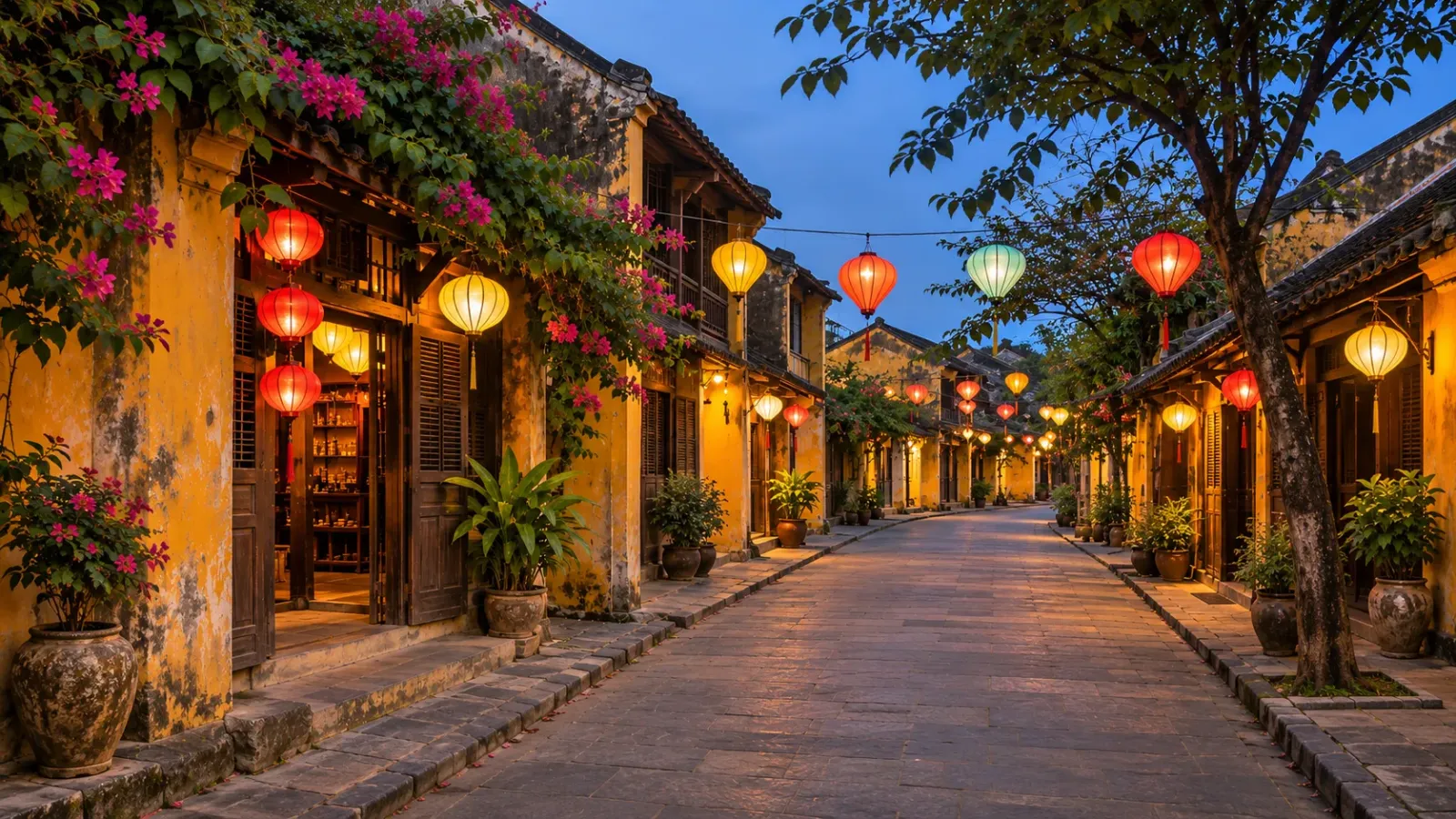
Lanterns come on along the old town's lanes in the early evening, the busiest time for strolling.
Hoi An Ticket at a Glance
The short version: buy at an official booth or self-service kiosk, check what your ticket covers before you pay, and keep it with you while you are in the old town.
| Topic | What to know |
|---|---|
| Statutory per-building fee | 20,000 VND per person per heritage building, set by Da Nang City from 10 August 2026; not confirmed as a ticket you can buy on its own |
| Sightseeing packages | 80,000 VND (three visits) and 120,000 VND (five visits), published in January 2026; current booth use not confirmed |
| Nationality | The city's January 2026 price table lists 80,000 VND for Vietnamese and 120,000 VND for international visitors; the later fee resolution applies one rate to everyone |
| What you can enter | The Japanese Covered Bridge or Quan Cong Temple, museums, assembly halls, old houses and family chapels |
| Free entry | Includes children under 16 and school pupils; see the full list below |
| Where to buy | Official booths on the approaches to the old town and self-service kiosks |
| Walking-street hours | Around 9am to 9:30pm in summer and 9am to 9pm in winter |
| Run by | Hoi An Centre for the Conservation of World Cultural Heritage, 10B Tran Hung Dao, Hoi An Ward, Da Nang City |
Since July 2025, the former Quang Nam province has been part of Da Nang City, which is why the fee rules for Hoi An are now set by Da Nang. For an overview of the town and the tours that include it, see our Hoi An page.
What You Pay in 2026
The Per-Site Fee Since 10 August 2026
In February 2026, the Da Nang City People's Council set fees for Hoi An's cultural buildings at 20,000 to 30,000 VND per person per building, applied equally to Vietnamese and foreign visitors. An amendment that took effect on 10 August 2026 fixed the Hoi An fee at 20,000 VND per person per building. The same resolutions set the fees at My Son Sanctuary and other heritage sites in the city.
This is a statutory fee level. It does not by itself show that visitors can buy individual 20,000 VND tickets for single buildings, and we found no official notice describing how it is sold at the booths.
The Package Tickets Published in January 2026
Before the new fee rules took effect, the heritage centre's January 2026 notice described two packages, each including general access to the old town:
- 80,000 VND: the Japanese Covered Bridge or Quan Cong Temple, plus two other heritage buildings of your choice
- 120,000 VND: the Japanese Covered Bridge or Quan Cong Temple, the museum system (described in the English notice as one museum of your choice), plus three other heritage buildings of your choice
The heritage centre's notice describes the packages by what they include. Da Nang's tourism portal, in its January 2026 price table, lists them as 80,000 VND for Vietnamese visitors and 120,000 VND for international visitors. As of 16 November 2026, we could not find an official update explaining how these packages relate to the August fee change or whether they are still sold in the same form.
What to Check at the Booth
Because the published information does not line up, the price board at the booth is the best guide on the day. Before paying, check:
- which ticket options are on sale and what each one costs
- how many buildings each option lets you enter, and whether the Japanese Covered Bridge is included
- how long the ticket is valid
- whether your children qualify for free entry
Do You Need a Ticket Just to Walk the Old Town?
The heritage centre asks visitors to buy a ticket before visiting the ancient town, and the money goes towards restoring its buildings. A ticket is required to go inside the ticketed heritage buildings.
Walking the streets is less clear-cut. In May 2023, when Hoi An tightened ticket checks, city officials said controls would focus on tour groups, that families and other small independent groups would not be required to buy, and that people coming into the old town to eat, drink coffee or take wedding photos would not need a sightseeing ticket.
If you are travelling independently and only plan to stroll, eat and photograph the lanterns, that May 2023 statement suggests a ticket is not required, though buying one supports the town's upkeep. We could not confirm that the same arrangements apply today, so if you want to go inside any heritage building, are travelling with a tour group, or are unsure what applies to you, ask at a booth.
What the Ticket Lets You Visit
Ticketed visits cover around 20 heritage buildings, including old merchant houses, Chinese assembly halls, communal houses, family chapels and small museums. The list on the route can change, so ask at the booth for the current one.

Under the January 2026 packages, every ticket included a visit to the Japanese Covered Bridge or Quan Cong Temple.
The Japanese Covered Bridge and Quan Cong Temple
Under the January 2026 packages, every ticket included a visit to one of these two landmarks. For most first-time visitors, the Japanese Covered Bridge is the obvious pick. It reopened in August 2024 after a 19-month restoration, so its paintwork looks brighter than in older photographs, and it gets busy from mid-afternoon into the evening. Quan Cong Temple is a calmer alternative if you have crossed the bridge on an earlier trip.
Museums, Assembly Halls and Old Houses
The rest of the ticketed buildings fall into a few groups: small museums on the town's history and trade, the assembly halls built by Chinese merchant communities, and family-owned old houses where the front rooms are open to visitors. Each building you enter uses one visit on your ticket.
Extras: Performances, Tea Ceremony and Night Town
The heritage centre's 2026 notices also list cultural activities for visitors:
- Traditional art performances: since 7 March 2026, held in the second-floor hall at Hoai River Square, 01 Cao Hong Lanh Street (moved from 66 Bach Dang Street), at 10:15am, 3:15pm and 4:15pm daily
- Japanese tea ceremony: at the Japanese Cultural Exhibition House, 06 Nguyen Thi Minh Khai Street, at 9:30am and 4:30pm daily
- Night Town activities: bai choi (a sung card game), folk games, folk singing and street performances with traditional instruments in the evening
Show times can change, so confirm them at a booth on the day.
How Long a Ticket Lasts
For the package tickets, the heritage centre's English notice of January 2026 and the city tourism portal in March 2026 both said one ticket covers your stay in Hoi An for up to three days, and that you should keep the stub to move in and out of the old town. Many websites still say 24 hours or the day of purchase only; those descriptions do not match the 2026 notices.
We could not verify, as of 16 November 2026, whether the August 2026 fee change affected how long a ticket lasts. Whatever you buy, check the validity at the booth and keep the ticket with you until you leave Hoi An.
Where and How to Buy Your Ticket
Official Booths at the Old Town Entrances
Tickets are sold at official booths on the main streets leading into the old town, so you will usually pass one soon after arriving. Booth hours published by the city in 2023 were 7:30am to 9:30pm in summer and 7:30am to 9pm in winter; check the hours posted at the booth, as they may have changed.
Carrying some Vietnamese dong in cash is a sensible backup in case a card or QR payment does not work. The price shown at the official booth is the one to pay.
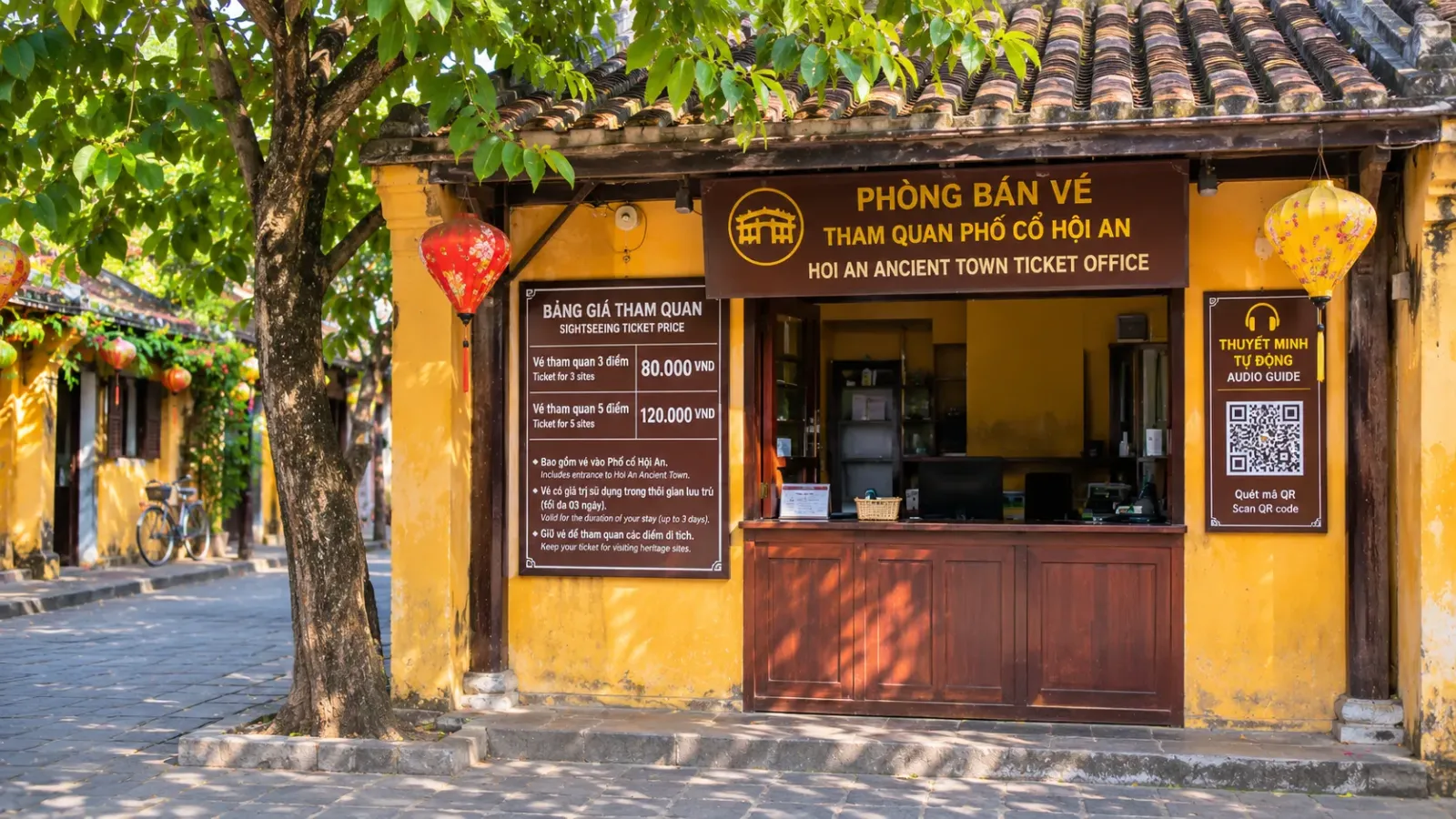
Booths and self-service kiosks on the approaches to the old town sell tickets; read the price board before paying.
Self-Service Kiosks and the QR Audio Guide
In February 2026 the heritage centre launched self-service ticket kiosks with a multilingual interface, international payment options and on-site ticket printing. A separate service lets you scan QR codes along the route and listen to an audio guide on your own phone. If a kiosk is out of order or busy, buy from a staffed booth instead.
Online Resellers and Hotel Desks
We could not confirm an official online purchase channel as of 16 November 2026; staffed booths and on-site kiosks are the documented ways to buy. Some websites sell vouchers that must be exchanged for a real ticket, and these may add a service fee, so check the final price, where the voucher is exchanged and the cancellation terms before you pay. In 2023 the city also said tickets would be available through accommodation in the old town, so it is worth asking at reception.
Who Enters Free
The exemptions published with Da Nang City's February 2026 fee resolution cover:
- Children under 16 and school pupils
- Vietnamese citizens aged 60 and over
- Vietnamese citizens with a qualifying disability certificate
- Vietnamese citizens covered by specified cultural-benefit policies
- Diplomatic guests
The under-16 exemption is not limited to Vietnamese citizens in the published wording, but carry your children's passports or photos of them in case staff ask for proof of age. Groups buying eight or more package tickets were also offered a free guide for the old town in the January 2026 notice. Da Nang's January 2026 tourism price table listed a height-based children's price of 50,000 VND, which differs from the later fee resolution. Ask the ticket staff which rule applies to your children.
How to Plan Your Visits
Mornings are the calmest time to go inside. Heritage buildings keep daytime hours that vary by site, and the city tourism portal lists 8am to 5pm as reference hours for the old town, so plan your visits for the day and save the evening for the lantern-lit streets and Night Town. These combinations each include one of the two landmarks and one museum, following the January 2026 package structure:
- Trading-port history: Japanese Covered Bridge, Museum of Trade Ceramics, Fujian Assembly Hall, Tan Ky Old House and the Cantonese Assembly Hall
- A quieter route: Quan Cong Temple, Museum of Folk Culture, Tran Family Chapel, Duc An Old House and the Trieu Chau Assembly Hall
- Short visit with children: Japanese Covered Bridge, Museum of Folk Culture and one old house, plus a 10:15am or 3:15pm show at Hoai River Square
If Hoi An is one stop on a longer trip, our two-week Vietnam itinerary shows how much time to give it.

Old merchant houses and Chinese assembly halls make up most of the buildings you can enter with a ticket.
When Ticket Sales Pause: Floods, Tet and Festival Days
Flood Season, October to December
The central coast's rainy season runs roughly from October to December, and the Hoai River can rise into the old town. During recent floods, several heritage buildings closed and the booths stopped selling tickets while residents moved their belongings to safety. Closures are irregular, and individual buildings may reopen on different days.
If you are visiting in these months, check local news or ask your hotel the day before, and keep a spare day in your plans so your visits do not depend on one date.
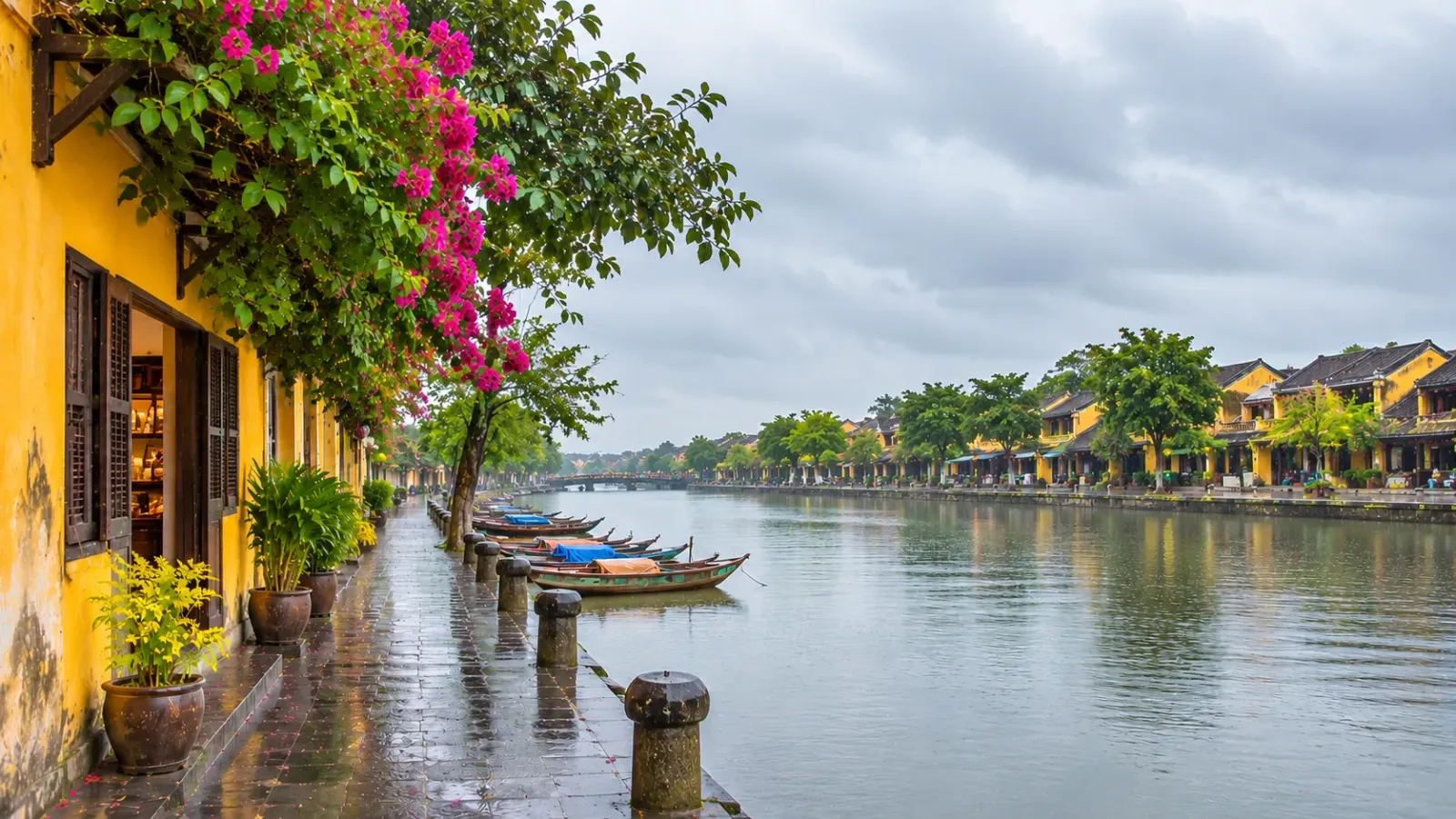
From October to December, high water on the Hoai River can close heritage buildings and pause ticket sales.
Tet 2027
Hoi An paused ticket sales over part of Tet 2026. The heritage centre stopped ticket sales and guided visits from 16 to 19 February, and the walking street and Night Town from 14 to 19 February. Privately and community-owned buildings on the route stayed open for New Year rituals, and visitors could still look around.
The first day of Tet 2027 falls on Saturday 6 February 2027, but arrangements for Tet 2027 had not been published as of 16 November 2026. Our guide to Tet 2027 in Vietnam explains what else closes and how to plan around the holiday.
Hoi An International Lantern Festival, 3 to 6 December 2026
The Hoi An International Lantern Festival runs from 3 to 6 December 2026 around Hoai River Square, the An Hoi sculpture garden and along the river. It coincides with the anniversary of Hoi An's UNESCO listing on 4 December 1999, so expect larger evening crowds. In 2025 the old town waived the ticket on 4 December to mark the anniversary; no waiver had been announced for 2026 at the time of writing.
Seeing Hoi An Old Town on a VietMediaTravel Trip
Our Bay Mau Coconut Forest and Hoi An evening tour from Da Nang lists the Hoi An Ancient Town entrance fee among its inclusions, along with a basket boat ride in Cam Thanh and dinner in Hoi An. If going inside particular heritage buildings matters to you, confirm which ones are visited on your departure when you book.
Coming down the coast from Hue? Our day tour from Hue to Hoi An by the Hai Van Pass turns the transfer into a day of sightseeing and drops you at your Hoi An hotel. For a longer stay in central Vietnam, we can plan a private itinerary around your dates.
Frequently Asked Questions
How much is the Hoi An Ancient Town ticket in 2026?
The heritage centre published sightseeing packages of 80,000 VND (three visits) and 120,000 VND (five visits) in January 2026, listed by Da Nang's tourism portal as the Vietnamese and international prices. Da Nang City also set a statutory fee of 20,000 VND per person per building from 10 August 2026. We could not confirm how the two are applied at the booths as of 16 November 2026, so check the price board before you pay.
Do I need a ticket to visit the Japanese Covered Bridge?
Going inside the bridge is one of the ticketed visits. Arrangements for walking through it can change with crowd control, so follow the staff on site. You can see and photograph the bridge from the surrounding streets and riverbank.
Is the ticket valid for more than one day?
The January 2026 package tickets were described as valid for your stay, up to three days. We could not verify whether this changed with the August 2026 fee rules, so check at the booth and keep your ticket until you leave.
Do children need a Hoi An ticket?
Da Nang City's February 2026 fee resolution exempts children under 16 and school pupils, but the city's earlier 2026 tourism price table listed a height-based children's price. Ask the ticket staff and carry proof of age.
Can I buy the Hoi An ticket online?
We could not confirm an official online channel as of 16 November 2026. Staffed booths and self-service kiosks in Hoi An are the documented ways to buy. Third-party vouchers exist, but check the final price and how the voucher is exchanged before paying.