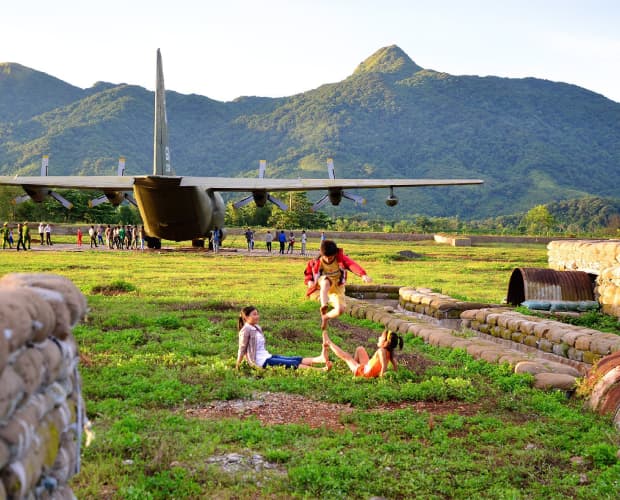
Visiting the DMZ from Hue: Which Sites to See and How to Plan Your Day Trip
Quang Tri Tours & Day TripsBy Pham Phuong Anh
Vinh Moc Tunnels, Hien Luong Bridge, Khe Sanh or all three? This guide explains which DMZ sites suit your interests, whether a shorter coastal trip or a full day makes sense, how a group tour compares with a private car and what to expect underground, so you can plan a respectful, well-paced day from Hue.

Table of contents
If you are short on time or simply curious, make a shorter trip to the coast north of Dong Ha: stand on Hien Luong Bridge, on the old demarcation line between North and South Vietnam, then walk through the Vinh Moc Tunnels, where a whole village lived underground. If military history is your main interest, make it a full day and add Route 9 to Khe Sanh in the western hills. Even the shorter trip takes longer than it sounds: allow roughly five and a half to seven hours from Hue, depending on traffic and stops. Many full-day DMZ itineraries from Hue combine the coastal sites with Khe Sanh, but routes vary. This guide explains what each site is really like, how the two plans compare and how to visit thoughtfully.
The former Demilitarized Zone lies in Quang Tri province, roughly 70 km north of Hue by road to the town of Dong Ha and about 100 km to Vinh Moc on the coast. Since the July 2025 provincial merger, Quang Tri also includes the former Quang Binh province, so you may see Phong Nha listed under Quang Tri as well.
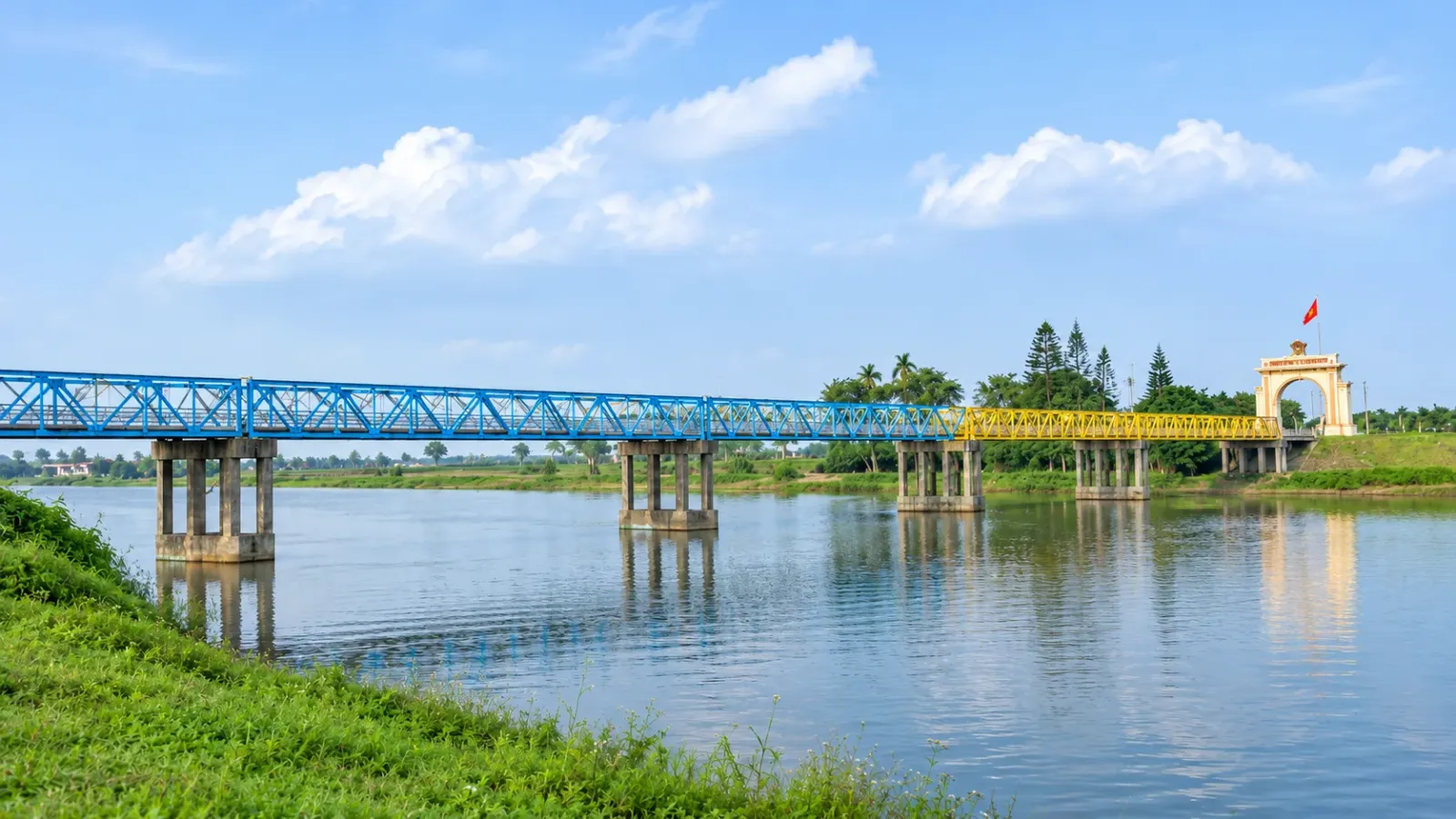
The Ben Hai River formed the temporary military demarcation line after 1954; the Hien Luong site reopened in April 2026.
The DMZ in brief: what you are actually visiting
The 1954 Geneva Accords set a temporary military demarcation line between North and South Vietnam, following the Ben Hai River close to the 17th parallel. A buffer of up to about 5 km on each side of the line became the Demilitarized Zone, or DMZ. It was meant to be temporary, but the line held for more than 20 years and the land on both sides became some of the most fought-over and heavily bombed terrain of the war.
Today, the DMZ is not a single fenced site but a stretch of quiet countryside: rice fields, plantations, small towns and the coast. What you visit are memorials, museums, rebuilt landmarks and the traces of former bases. Some stops are moving and well presented; others are little more than a monument by the road. Going in with that expectation, and with a good guide or some background reading, makes the day far more rewarding.
For an overview of everything else to see in the province, from the coast to Phong Nha's caves, see our Quang Tri tours and day trips.
Which DMZ sites are worth your time
The sites fall into two groups: those along the coast and Highway 1 north of Dong Ha, and those along Route 9, which runs west from Dong Ha into the hills towards Khe Sanh and the Lao border. Times below are approximate and include a short walk around each site.
| Site | What you see | Time on site | Best for | On our full-day tour? |
|---|---|---|---|---|
| Vinh Moc Tunnels | A three-level tunnel village where families lived during the bombing, plus a small museum | About 1–1.5 hours | Everyone who can manage low passages | Yes |
| Hien Luong Bridge and Ben Hai River | The former dividing line, the flagpole on the north bank and a small exhibition | About 30–45 minutes | Understanding the division | Yes |
| Khe Sanh Combat Base (Ta Con) | A former US Marine base and airfield with a small museum, bunkers and aircraft | About 1 hour | Military history readers and veterans | Yes |
| Quang Tri Citadel | A memorial park on the site of the 1972 battle | About 30–45 minutes | History and remembrance | Yes |
| Long Hung Church | The shell of a church left as a wartime ruin | About 15–20 minutes | A short, striking stop | Yes |
| Dakrong Bridge | A bridge in the mountains on a former Ho Chi Minh Trail route | About 10–15 minutes | Scenery on Route 9 | Yes |
| Doc Mieu Base | The site of a former base near the demarcation line | About 15 minutes | Completing the coastal circuit | Yes |
| Truong Son National Cemetery | Vietnam's national cemetery for soldiers who died on the Truong Son (Ho Chi Minh) Trail | About 30–45 minutes | Quiet reflection | Not on this group tour |
| Mine Action Visitor Center, Dong Ha | Exhibits on unexploded ordnance and clearance work | About 30–45 minutes | Understanding the war's legacy today | Not on this group tour |
Vinh Moc Tunnels
If you see only one site, make it Vinh Moc. Villagers dug the tunnels between 1965 and 1967 to escape relentless bombing north of the river, and families lived, cooked and worked underground for years; 17 children were born there. The complex has three levels, the deepest about 23 m below ground, and 13 entrances, seven of them opening towards the sea. It is now a special national relic, and the entrances, connecting trenches and sections of the upper levels were restored recently, so the visit feels well cared for. More on what it is like inside below.
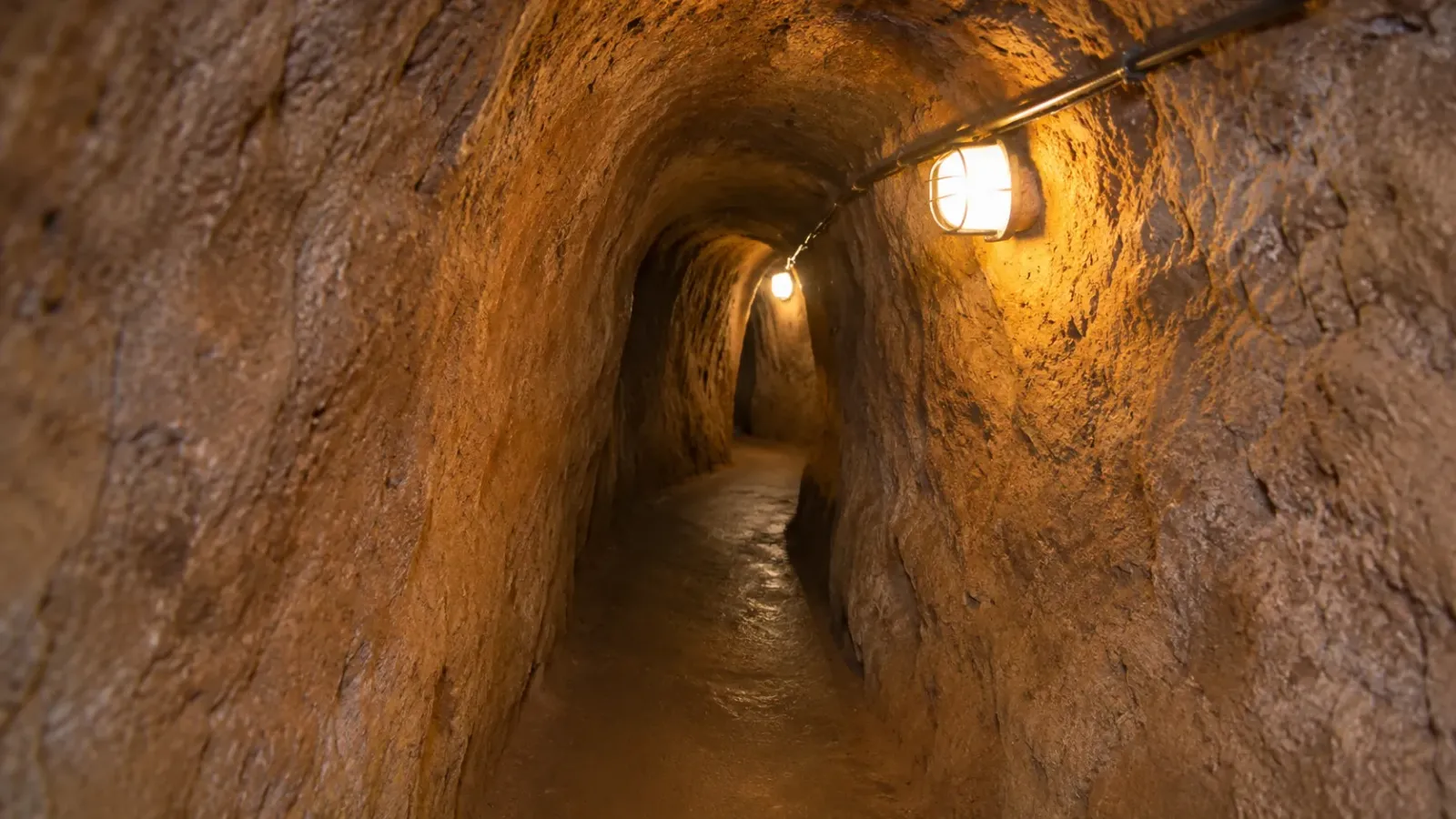
Many passages are low and narrow; ask staff or your guide about the shortest visitor route before going underground.
Hien Luong Bridge and the Ben Hai River
Hien Luong Bridge is where the country's division becomes tangible. For two decades the crossing separated North from South, and both sides used flags and loudspeakers to make their point across the water. The restored Hien Luong–Ben Hai historical site reopened to visitors on 1 April 2026. You can walk across the bridge, look at the flagpole on the north bank and visit the small exhibition. It is also a brief stop on many day trips from Hue to Phong Nha, so you may already pass it on another day.
Khe Sanh Combat Base (Ta Con Airfield)
Khe Sanh, in the hills about 60–65 km west of Dong Ha along Route 9 and close to the Lao border, was the scene of one of the war's best-known battles. In early 1968 about 6,000 US Marines and South Vietnamese troops were besieged here for some 77 days. Today the site, known locally as Ta Con Airfield, has a small museum, reconstructed bunkers and trenches, and aircraft and helicopters on display; a C-119 transport aircraft was added in 2026. The exhibits present the battle from the Vietnamese perspective, which many visitors find a valuable part of the experience. The drive itself, through green hills and coffee country, is a highlight for many people.
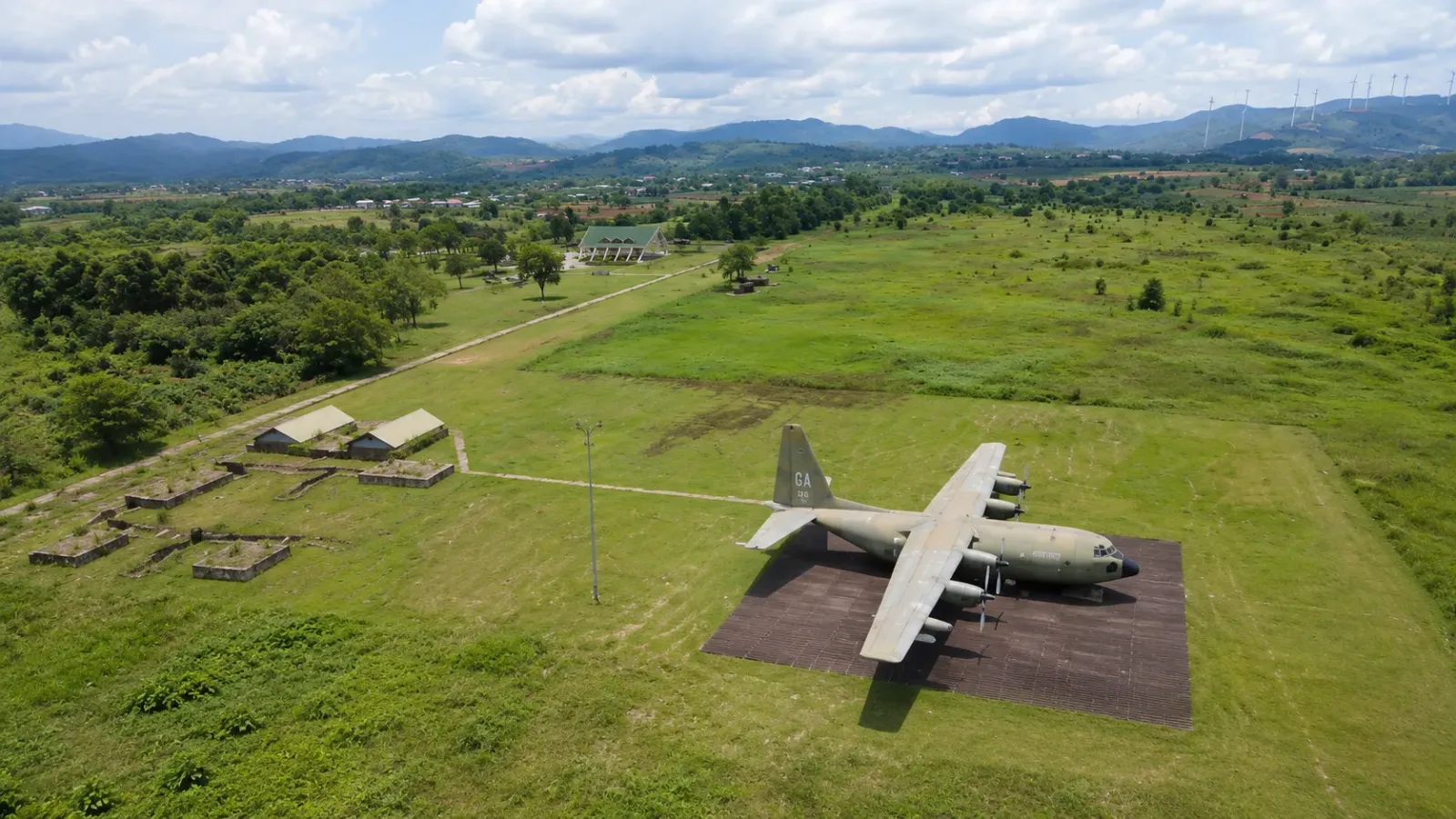
The former Khe Sanh airfield now features a small museum, reconstructed bunkers and military aircraft displays.
Quang Tri Citadel and Long Hung Church
Little remains of the old citadel in Quang Tri town, which was destroyed during 81 days and nights of fighting from late June to mid-September 1972. The site is now a special national relic and a memorial park where Vietnamese visitors come to light incense. Nearby Long Hung Church was held as a defensive position in 1972 and has been kept as a ruin. A restoration project covering the Citadel, Bo De School and Long Hung Church was reported completed in March 2026. Access to particular areas may still vary, so follow the site's current visitor guidance.
Shorter stops along the way
Dakrong Bridge and Doc Mieu Base are brief stops on the full-day route. On a private trip you can add the Rockpile, a limestone outcrop used as a lookout and seen from the road; Truong Son National Cemetery, a vast and peaceful resting place for soldiers who died along the trail; and the Mine Action Visitor Center in Dong Ha. Run by Project RENEW, the center explains how unexploded ordnance still affects the province today. It opens on weekdays (weekend visits by arrangement), entry is free and donations are welcome. These three are not part of our full-day tour.
Shorter trip or full day: two ways to plan it
The choice comes down to how much time you want to spend in a vehicle. Vinh Moc and Hien Luong are close together on the coast, while Khe Sanh adds a long detour west and back.
| Comparison | Shorter trip: coastal north | Full day: coast plus Route 9 |
|---|---|---|
| Main sites | Hien Luong Bridge, Vinh Moc Tunnels, optionally Doc Mieu or the Citadel | All of the above plus Dakrong Bridge, Khe Sanh and Long Hung Church |
| Driving from Hue | About 2 hours each way to Vinh Moc | A long circuit with substantial driving between the coastal sites and Khe Sanh; total distance depends on the route and stops |
| Typical length | Roughly 5½–7 hours from Hue, depending on traffic and stops: an extended half day rather than a three- or four-hour outing | A full day, early start to evening return |
| Best for | Curious travelers, families, anyone short on time | Military history enthusiasts, veterans and their families |
| Trade-off | You miss Khe Sanh and the hill scenery | Some stops are short, and it is a tiring day |
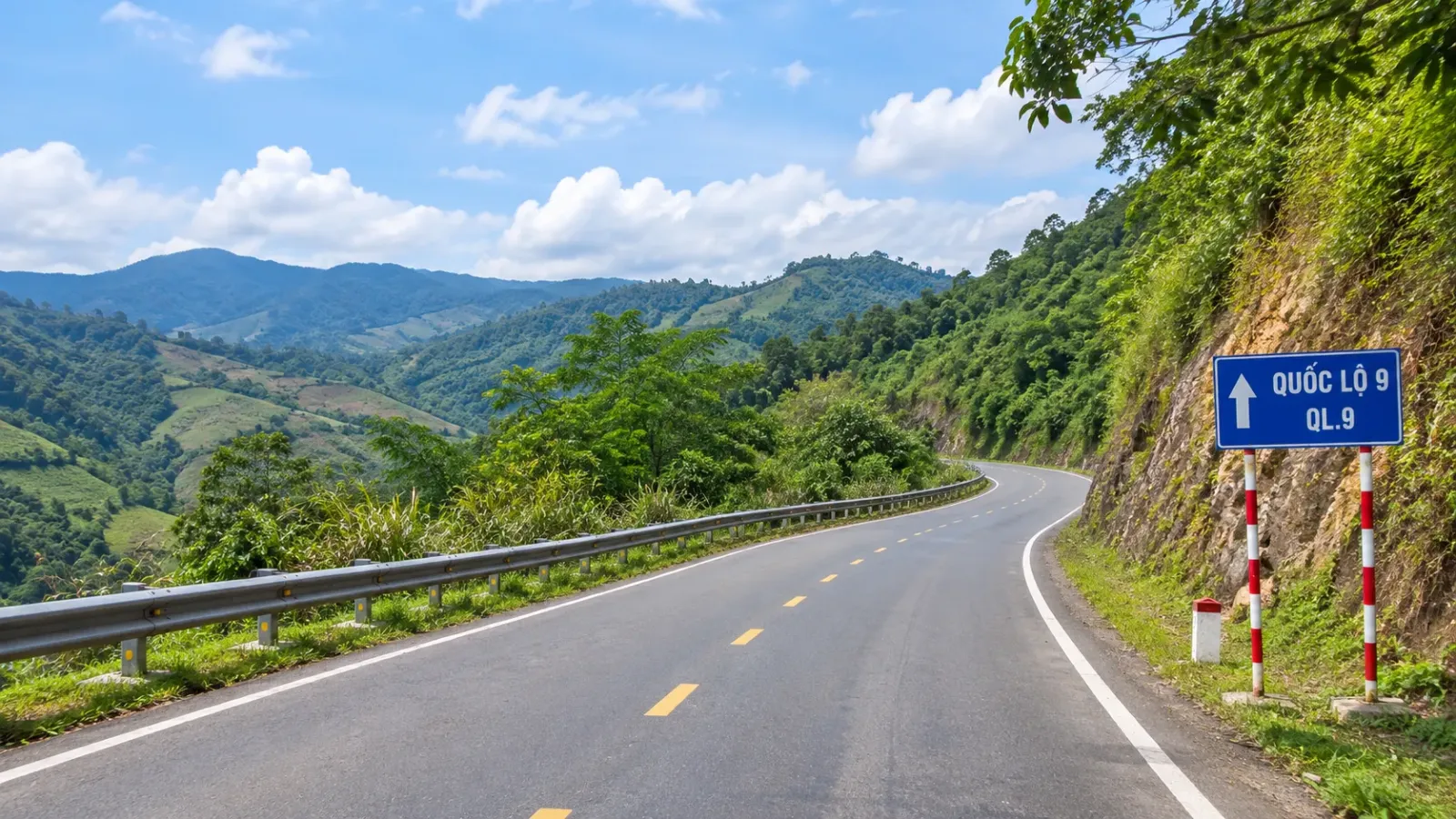
The full-day route follows Route 9 into the western hills, adding scenery but also several hours of driving.
Group tour, private car or motorbike
Guided group day tour
The simplest option. Transport, entrance fees and a guide's commentary are taken care of, and the guide is what turns a field with a monument into a story. The trade-off is a fixed route and schedule: you cannot linger at Vinh Moc or skip a stop that interests you less.
Private car with driver (and guide)
A private car lets you choose the sites and set the pace. That is ideal for the shorter coastal trip, for veterans who want to find specific places, or for adding Truong Son Cemetery or the Mine Action Visitor Center. A driver alone will get you there but will not explain much, so for the full experience book an English-speaking guide too. We can arrange this as a private itinerary.
Motorbike or self-guided
Riding yourself offers the most freedom, but it is a long day on busy Highway 1 plus hill roads, in heat or rain. Only consider it if you are an experienced rider. Licence and insurance rules depend on your nationality: the UK government, for example, says British visitors need a 1968 International Driving Permit together with their national licence, and third-party insurance is a legal requirement. Helmets are compulsory for riders and passengers.
What a DMZ day from Hue looks like
On our full-day tour, the guide and driver pick you up at 07:00 from the lobby of your hotel in central Hue and head north towards Dong Ha. The first stops are Long Hung Church and Quang Tri Citadel. The route then turns west along Route 9 to Dakrong Bridge and Khe Sanh. In the afternoon you return east to Hien Luong Bridge and the Ben Hai River, stop at Doc Mieu Base and finish at the Vinh Moc Tunnels, before driving back to Hue for around 18:00.
Expect a lot of time in the vehicle between relatively short stops. That is the nature of the DMZ, not a flaw of any one itinerary. The guide's commentary on the road is a large part of what you are paying for. The tour includes an English- and Vietnamese-speaking guide, entrance fees and a light lunch.
Prefer an organized day? See our Quang Tri DMZ full-day tour from Hue.
Inside Vinh Moc Tunnels: what to expect
The tunnels are dug from compacted clay and lit by electric lights. Many passages are low and narrow, so taller visitors will need to stoop for long stretches, and two people cannot easily pass each other. Small side chambers once served as family rooms, and you will also pass a meeting hall, ventilation shafts and the small room where babies were delivered. Several of the tunnel's entrances open towards the sea, and the view across the water is a welcome release after the dark.
Ask staff or your guide about the shortest visitor route and the available exits before going underground. If enclosed spaces are uncomfortable, visit the above-ground exhibits and trenches instead; there is no obligation to go through the tunnels. Wear shoes with good grip, as the floor can be damp, and keep bags small.
Visitors who have seen the tunnels near Ho Chi Minh City often ask how the two compare. Cu Chi was a guerrilla base built for fighting; Vinh Moc was a village built so that ordinary families could survive. Many sections of Vinh Moc feel roomier than the narrowest visitor crawl sections at Cu Chi, though you may still need to stoop, and the coastal setting gives it a very different feel. For the southern sites, see our guide to Ben Dinh vs Ben Duoc.
Visiting respectfully and safely
Quang Tri was among the most heavily bombed areas of the war, and unexploded ordnance is still found today, even during building work in towns. The UK government's travel advice warns that landmines and other unexploded weapons remain a hazard in former battlefields, especially in central Vietnam, and that mined areas are often unmarked. At every site, stay on paths and visitor areas, never pick up or touch metal objects, and do not wander into fields or scrub for a photo. If you see something suspicious, keep away and tell your guide.
Many places on the route are cemeteries and memorials where Vietnamese families still come to mourn. Dress modestly, with shoulders and knees covered, keep voices low, and ask before photographing people paying their respects. Veterans and their families are generally welcomed at these sites. If you are returning to a place with personal significance, a private trip with a well-briefed guide gives you the time and flexibility the visit deserves.
Best time to go
The DMZ can be visited all year, but the weather shapes the day. October and November bring heavy rain and seasonal flooding to central Vietnam, and the wider rainy season runs into December. Heavy rain can disrupt access to the western hill roads towards Khe Sanh, so check local warnings and road conditions before departing; outdoor stops are also hard going in a downpour. If you travel then, keep a spare day, check the forecast and be ready to switch to the shorter coastal plan. Our guide to flood and typhoon season in central Vietnam explains how to plan around it.
From late spring through summer the region is hot, with dry westerly winds that can make open sites such as Khe Sanh and the Citadel draining in the middle of the day. Start early, carry plenty of water and save the tunnels, which stay cooler, for the hottest part of the day if your itinerary allows. Late winter and spring are generally the most comfortable months.
Combining the DMZ with Phong Nha
The caves of Phong Nha lie further north than the DMZ, and day trips from Hue to the caves usually include a brief stop at Hien Luong Bridge on the way. If that stop is enough for you, you have already seen the dividing line and can choose a cave day instead. Our guide comparing Paradise, Phong Nha and Dark Cave helps you pick one.
Trying to fit the full DMZ circuit and a cave into one day from Hue is not realistic. If you want both, travel north in stages: spend a day on the DMZ, sleep in Dong Ha or continue to Phong Nha for the night, then visit the caves the next day. For a wider route, our two-week Vietnam itinerary treats a DMZ day or a Phong Nha cave day as alternative choices from Hue.
What to bring
- Comfortable shoes with good grip for damp tunnel floors and uneven paths.
- Clothes that cover shoulders and knees for cemeteries and memorials.
- Water, a hat and sunscreen for exposed sites, or a rain jacket from October to December.
- A small torch or phone light, optional but handy in the tunnels.
- Some small Vietnamese banknotes for drinks, snacks or a donation.
- Snacks for the long drives between stops.
FAQ
How far is the DMZ from Hue?
Dong Ha, the gateway town, is about 70 km north of Hue by road, and the Vinh Moc Tunnels on the coast are about 100 km away, roughly a two-hour drive. Khe Sanh is a further 60–65 km west of Dong Ha.
Can I visit the key DMZ sites in a shorter trip from Hue?
Yes, if you focus on the coast: Hien Luong Bridge and the Vinh Moc Tunnels give you the essence of the DMZ. Allow roughly five and a half to seven hours from Hue, depending on traffic and stops. You will need a full day to add Khe Sanh and Route 9.
Vinh Moc or Khe Sanh if I can visit only one site?
For most travelers, Vinh Moc: it is closer, easier to understand without much background and memorable for all ages. Choose Khe Sanh if you have a specific interest in the 1968 battle or a personal connection to it.
Are the Vinh Moc Tunnels suitable for tall or claustrophobic visitors?
Tall visitors will need to stoop, and the passages are narrow. Many sections feel roomier than the narrowest crawl sections at Cu Chi, but if enclosed spaces worry you, ask staff about the shortest route and exits before going in, or stay above ground; the museum and trenches are still worthwhile.
Is it safe to explore the DMZ on my own?
The managed visitor areas are generally accessible, but stay on designated paths and follow site instructions: unexploded ordnance remains a hazard outside them. The bigger challenges for independent travelers are the distances and the lack of context, which is why many visitors go with a guide.
Can I visit the DMZ in the rainy season?
Usually yes, but heavy rain in October and November can disrupt access to the western hill roads and make outdoor stops unpleasant. Keep your plans flexible and be ready to shorten the route to the coastal sites.
How are the Vinh Moc Tunnels different from the Cu Chi Tunnels?
Cu Chi was a guerrilla base near Ho Chi Minh City; Vinh Moc was a village where families lived underground to survive the bombing. Vinh Moc reaches about 23 m at its deepest, many of its sections feel roomier, and several entrances open onto the sea.
Ready to go? Join our Quang Tri DMZ full-day tour, or tell us what you would like to see and we will plan a private DMZ day from Hue at your own pace.
Related articles

Nha Trang Island Hopping 2026–27: Which Islands, Which Boat and What to Expect Now

Hue to Hoi An via the Hai Van Pass: How to Make the Trip and What You’ll See

3 Days in Ho Chi Minh City: A Day-by-Day Itinerary for First-Time Visitors

Best Time to Visit Vietnam: A Month-by-Month Guide to the North, Centre and South

Central Vietnam Flood & Typhoon Season: When It Happens and How to Plan Your Trip

Hoi An Ancient Town Ticket 2026–27: Fees, What It Covers and How to Use It

Cai Rang Floating Market 2026–27: What It’s Like Now and How to Visit