Hue Imperial City & Royal Tombs 2026–27: Tickets, Combos and Which Tombs to Choose
Vietnam Travel TipsBy Pham Phuong Anh
Hue’s heritage fees are set by a city resolution that took effect in January 2026. This guide turns it into a plan: what each ticket and combo costs, when a combo actually saves money, how Tu Duc, Minh Mang and Khai Dinh differ, how to fit them into half a day or two, and what to wear at the gate.

Table of contents
If you want to see the Imperial City and all three of the best-known royal tombs, buy the four-site combo for 530,000 VND and spread it over two days. If you only have time for two tombs, the three-site combo costs 420,000 VND. As for which tombs: Tu Duc for lakes and gardens, Minh Mang for scale and symmetry, and Khai Dinh for something completely different, as long as you are happy to climb steps.
Prices in this guide follow the fee schedule that Hue City adopted for its heritage sites from 4 January 2026, and were checked on 20 November 2026. Foreign and Vietnamese visitors pay the same rates, but Vietnamese citizens also get a few free days a year. Below you will find what each ticket covers, when a combo really saves money, how the tombs differ and how to fit them into your stay.

The Imperial City ticket covers the palace grounds behind Ngo Mon; the Royal Antiquities Museum is ticketed separately.
Hue Tickets at a Glance
| Ticket | Adult | Child (7–12) | Valid for | Best for |
|---|---|---|---|---|
| Imperial City only | 200,000 VND | 40,000 VND | One visit | A half-day in the city with no tombs |
| One main tomb (Tu Duc, Minh Mang or Khai Dinh) | 150,000 VND | 30,000 VND | One visit | Adding a single tomb |
| Imperial City + two main tombs | 420,000 VND | 80,000 VND | Up to 48 hours from your first site visit | One full day |
| Imperial City + all three main tombs | 530,000 VND | 100,000 VND | Up to 48 hours from your first site visit | Most first-time visitors |
| All sites | 600,000 VND | 120,000 VND | Up to 120 hours (five days) from your first site visit | Three days or more in Hue |
Children under 7 enter free. Prices are per person, per visit.
What You Pay in 2026
Hue's heritage fees are set by the city's People's Council. The current schedule, Resolution 55/2025, was passed in December 2025 and took effect on 4 January 2026. It kept the single-site and two- and three-site combo prices that visitors were already paying, and confirmed the four-site and all-sites passes.
Single-Site Tickets
The Imperial City (Dai Noi) costs 200,000 VND for adults and 40,000 VND for children aged 7 to 12. Each of the three main tombs, Tu Duc, Minh Mang and Khai Dinh, costs 150,000 VND, or 30,000 VND for a child.
The quieter sites cost less, and children enter them free: Gia Long's tomb is 150,000 VND and Dong Khanh's is 100,000 VND. The tombs of Thieu Tri and Duc Duc, the Hue Museum of Royal Antiquities, An Dinh Palace, Hon Chen Temple and the Nam Giao Esplanade are 50,000 VND each.
One detail catches people out: the Museum of Royal Antiquities sits just outside the Imperial City and has its own 50,000 VND ticket. It is not covered by the Imperial City ticket.
Combo Tickets: Three Sites, Four Sites or Everything
Combos bundle the Imperial City with the main tombs and are sold at the ticket counters and online:
- Three sites (420,000 VND): the Imperial City plus any two of Tu Duc, Minh Mang and Khai Dinh. There are three versions, one for each pair of tombs, each valid for up to 48 hours from your first site visit.
- Four sites (530,000 VND): the Imperial City plus all three main tombs, valid for up to 48 hours from your first site visit.
- All sites (600,000 VND): every site the Hue Monuments Conservation Centre sells tickets for, valid for up to 120 hours from your first site visit.
There are also smaller two-site combos: Tu Duc with Dong Khanh for 200,000 VND, Minh Mang with Gia Long for 240,000 VND, and the Museum of Royal Antiquities with An Dinh Palace for 80,000 VND.
According to the Conservation Centre's 2026 visitor information, two-, three- and four-site combos are valid for up to 48 hours from your first site visit, and the all-sites pass for up to 120 hours. Keep your ticket or QR code until you have visited every included site, because it is checked at each one.
When a Combo Actually Saves Money
- Imperial City plus two tombs: 500,000 VND as single tickets, or 420,000 VND as a combo. You save 80,000 VND per adult.
- Imperial City plus three tombs: 650,000 VND as single tickets, or 530,000 VND as a combo. You save 120,000 VND per adult and 30,000 VND per child.
- Three tombs only, no Imperial City: there is no tomb-only combo for the big three, so you pay 450,000 VND in single tickets. The four-site combo costs only 80,000 VND more and adds the Imperial City.
- Four-site combo or all-sites pass: add Gia Long, or any two of the 50,000 VND sites, to the four-site combo and the total passes 600,000 VND. At that point the all-sites pass is cheaper and gives you five days instead of two.
If you only want one tomb and the Imperial City, single tickets are your only option: 350,000 VND.
Who Enters Free or Pays Less
- Children under 7 enter free. The child rate applies from 7 to 12.
- Free days for Vietnamese citizens: the first day of Tet and 26 March, 19 August, 2 September and 23 November. International visitors pay the normal fee on these days, and the sites are much busier.
- Free entry also applies to people with especially severe disabilities.
- Half price (50%) applies to people with severe disabilities, older Vietnamese citizens, Hue residents and some student groups. Do not assume the age-based reduction extends to foreign visitors; if you think you qualify for any reduction, bring your passport or supporting documents and ask at the booth.
Which Tombs to Choose
Seven main imperial tomb complexes are usually counted around Hue, though some hold the graves of more than one emperor. All of them lie outside the walled city, among the hills along the Perfume River. Three are usually recommended: Tu Duc, Minh Mang and Khai Dinh. They are very different places, and you do not need to see all three to understand why Hue's tombs are famous.
Tu Duc: Lakes, Pavilions and Popular Paths
Tu Duc's tomb was built between 1864 and 1867 for the emperor with the longest reign of the dynasty. It feels more like a landscaped retreat than a grave: about 50 structures sit around a lake inside a wall roughly 1.5 kilometres long. It is the closest of the big three to the city, at around 6 to 7 kilometres, and one of the most visited, so arrive at opening time or in the late afternoon for quieter paths. Restoration of several buildings, including Hoa Khiem Palace and the Minh Khiem Duong theatre, is scheduled to continue until October 2027, so parts of the complex may be fenced off when you visit.

Tu Duc is the closest of the three main tombs to the city; arrive at opening time for quieter paths.
Minh Mang: The Grandest and Most Symmetrical
Completed in 1843, Minh Mang's tomb is the most formal of the three. Gates, courtyards, pavilions and bridges line up along a single axis, framed by lotus lakes and pine-covered hills. The emperor's burial mound lies behind a gate that is opened only once a year, but you can walk close to it. The tomb is the farthest of the three, about 12 kilometres from the city on the west side of the Perfume River, so it adds the most driving time. This is the one to choose if you care most about history and classic Nguyen architecture.

Minh Mang's tomb lines up its gates, pavilions and bridges on a single axis, about 12 km from the city.
Khai Dinh: Concrete, Mosaics and 127 Steps
Khai Dinh's tomb is the last and smallest of the imperial tombs, started on 4 September 1920 and finished in 1931 by his son, Bao Dai. Instead of timber pavilions in a park, it is a compact concrete building climbing a hillside, mixing Vietnamese, Chinese and European styles. Inside are walls covered in ceramic and glass mosaics. Reaching the top means climbing 127 steps, which matters if you travel with young children or have limited mobility. Allow 45 to 90 minutes. It lies roughly 9 to 10 kilometres south of the city. Some visitors find it the highlight of Hue and others find it over the top, which is exactly why it is worth seeing alongside a traditional tomb.
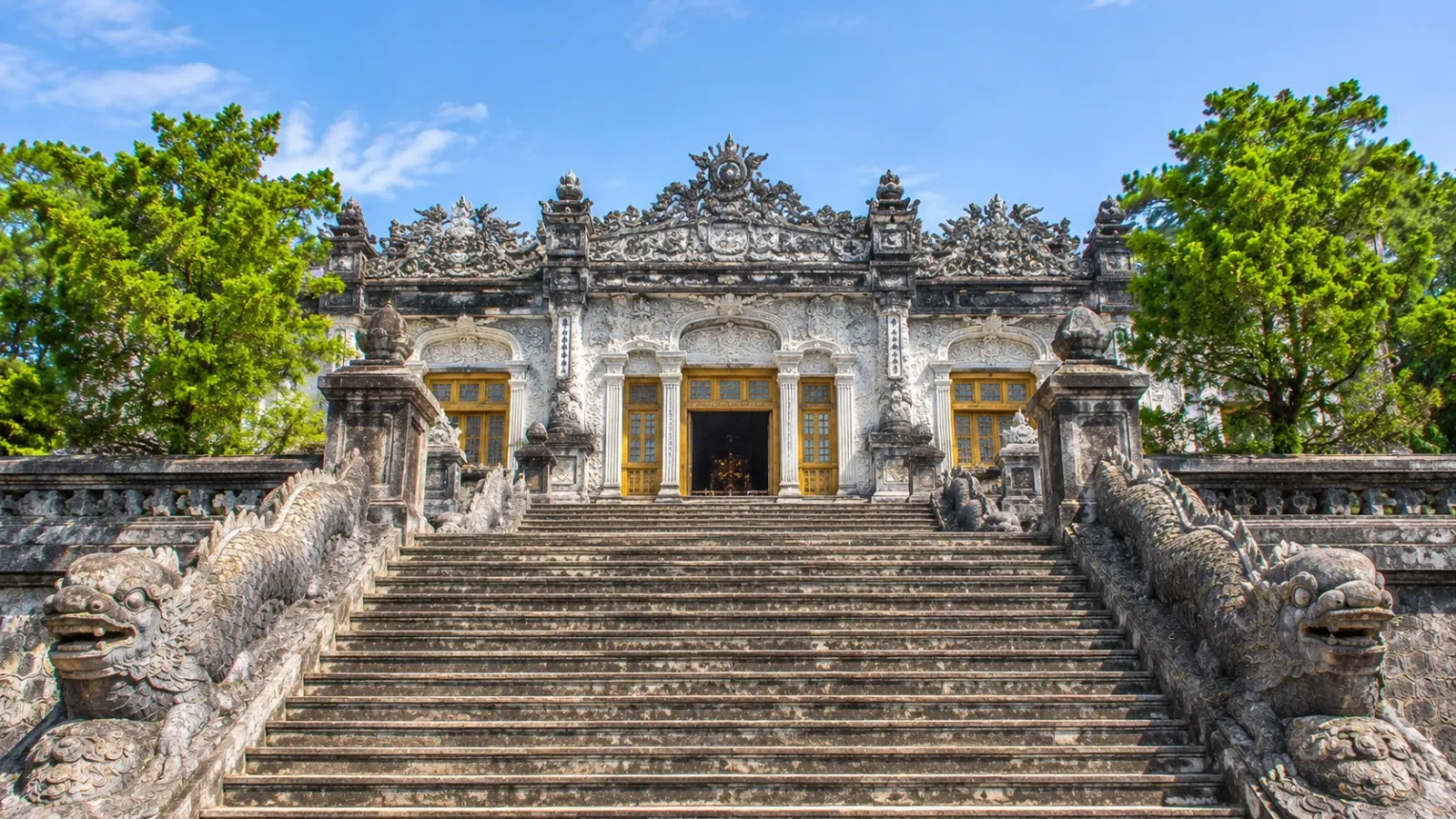
Reaching the top of Khai Dinh's tomb takes 127 steps, so plan extra time with young children.
Quieter Alternatives: Thieu Tri, Dong Khanh and Gia Long
If the big three feel too busy, the smaller tombs are cheaper and much calmer. Thieu Tri's is the only imperial tomb without an outer wall and sees few visitors. Dong Khanh's sits on a quiet hill and blends Vietnamese and European details; its two-site combo with Tu Duc costs 200,000 VND. Gia Long's tomb, the oldest, is about 16 kilometres from the city in open countryside and deserves a morning or afternoon of its own.
| Tomb | Built | What it feels like | Approx. distance from city | Effort | Choose it if you… |
|---|---|---|---|---|---|
| Tu Duc | 1864–1867 | Lake, pavilions, gardens | 6–7 km | Mostly manageable walking, some uneven paths | Want the prettiest setting and can go early |
| Minh Mang | Completed 1843 | Grand, formal, symmetrical | About 12 km | Long, flat walk | Care most about history and architecture |
| Khai Dinh | 1920–1931 | Concrete, mosaics, East–West mix | 9–10 km | 127 steps | Want something unlike anything else in Hue |
| Dong Khanh / Thieu Tri | Various | Quiet, smaller, fewer visitors | Dong Khanh is beside Tu Duc | Mostly manageable walking | Prefer calm over famous names |
| Gia Long | Completed 1820 | Remote, rural, spread out | About 16 km | Half a day including travel | Have extra time and like countryside |
If you only have time for one tomb: choose Tu Duc for atmosphere, Minh Mang for history, or Khai Dinh for spectacle. If you can manage two, pair one traditional tomb (Tu Duc or Minh Mang) with Khai Dinh to see the contrast. That is the logic behind the three-site combo.
Match Your Ticket to Your Time
- Half a day: the Imperial City only (200,000 VND). Allow two to three hours at a minimum.
- One full day: the Imperial City in the morning and two tombs in the afternoon with a car, on the three-site combo (420,000 VND). Because the combo is valid for up to 48 hours from your first site visit, you can also split it over two days. Tu Duc and Khai Dinh are the closer pair; choosing Minh Mang adds the most driving time.
- Two days: the four-site combo (530,000 VND). Do the Imperial City on day one and all three tombs on day two, starting with whichever tomb you want to see before the crowds arrive.
- Three days or more: the all-sites pass (600,000 VND), adding the Museum of Royal Antiquities, An Dinh Palace and one or two of the quieter tombs.
If Hue is one stop on a longer route, our two-week Vietnam itinerary gives it a full day with the Imperial City in the morning and tombs in the afternoon. That pattern fits the three-site combo.
Inside the Imperial City: What to See and What's Fenced Off
You enter through Ngo Mon, the Noon Gate, and follow the central axis across the bridge to Thai Hoa Palace, the throne hall. Thai Hoa has reopened after a restoration of nearly three years, and the European-influenced Kien Trung Pavilion further north has also reopened. Large parts of the complex were destroyed in the 20th century, so expect open lawns and foundations between the restored buildings.
Restoration is ongoing, and a few areas may be fenced off when you visit. Work on Can Chanh Palace is under way, and the rebuilding of Dai Cung Mon, the main gate into the Forbidden Purple City, is planned to run from 2026 to 2030. Since September 2025, visitors have not been allowed inside the inner hall of The Mieu, the temple dedicated to the Nguyen emperors; you can still see it from outside.
The grounds are large and shaded in places but hot at midday. Electric carts are available inside at extra cost if walking the whole site is too much.
Where and How to Buy Your Ticket
Booths at Each Site
Every site has its own ticket counter. If you plan to use a combo, buy it before your first site and keep the ticket safe, because it is checked again at each site.
The Official E-Ticket Site
The Hue Monuments Conservation Centre sells tickets online through its official e-ticket website, which is available in English. You enter by scanning a QR code. The Centre recommends booking ahead for the Imperial City and the three main tombs, which are the busiest sites. At the sites, the Centre encourages cashless payment by QR code, e-wallet or card, but carry some cash as a backup in case a terminal is not working. According to the Centre's ticket purchase guide, paid tickets are non-refundable, so check your sites, ticket type and dates carefully before you pay.
Resellers and Hotel Desks
Hotel desks and travel platforms may offer convenient booking options. Compare the final price, any service fees and the ticket conditions with the official e-ticket site before purchasing.
Opening Hours, Night Visits and Getting to the Tombs
Opening Hours
According to the Conservation Centre's published schedule, from 16 March to 15 October ticket counters operate from 6:30 to 17:30, entrance gates close at 18:00 and exit gates close at 18:30. From 16 October to 15 March, ticket counters operate from 7:00 to 17:00, entrance gates close at 17:30 and exit gates close at 18:00. Hours can change during floods, festivals and special events, so check the Centre's latest announcements before you visit. To avoid heat and tour groups, start at opening time, especially at Tu Duc. For the weather month by month, see our guide to the best time to visit Vietnam.
Can You Visit at Night?
Only during announced events, for now. In April 2026 the Imperial City opened free in the evenings for four nights as part of the Hue Festival, with a staged night programme. The city has said it wants to open after dark more regularly, but we have not seen a confirmed year-round schedule. If a night opening is announced while you are in town, it is well worth going, but do not plan your trip around one.
Getting Between the Tombs
The tombs are spread over several kilometres of hills south and west of the city and are not within walking distance of each other. Most visitors hire a car with a driver for a half or full day, or use taxis or ride-hailing apps between sites. Experienced riders can go by motorbike. Agree on the order in advance: Tu Duc and Dong Khanh are neighbours, Khai Dinh lies further south, and Minh Mang and Gia Long are the farthest out.
What to Wear and Site Rules
In July 2026 the Conservation Centre reissued its visitor rules, and guards can end the visit of anyone who ignores them:
- Cover up. Shorts, short skirts and tops that bare the shoulders are not allowed in palace interiors and places of worship. A light scarf or long trousers in your bag solves this.
- Remove hats before entering palace interiors, and keep your voice down.
- Do not touch artefacts, sit or climb on structures, or walk on the lawns.
- Drones are banned, and smoking is not allowed anywhere on the grounds.
- Commercial filming, performances and organised activities need permission in advance.
Special Discounts in Hue: Heritage Transport, Medical Travel and MICE
In early November 2026, Hue introduced a 50% discount on single-site tickets at five sites (the Imperial City, the tombs of Thieu Tri, Duc Duc and Dong Khanh, and the Museum of Royal Antiquities) for passengers on two heritage rail services: the Hue–Phong Nha tourist train and the Hue–Da Nang steam train. The steam train completed technical test runs over the Hai Van Pass in October 2026, so check with the rail operator that it is running before counting on the discount. The regular Hue–Da Nang heritage train is a separate service and is not named in the discount rules. On 14 November the city extended the rail discount to 31 May 2027 and added the same 50% for passengers on new air routes to Hue until the end of 2027.
Three things to know. First, it applies only to single-site tickets: combo tickets are not discounted, and Tu Duc, Minh Mang and Khai Dinh are not among the five sites. Second, you need to show a valid train or flight ticket, each one covers one admission at one site within seven days of travel, and the discount cannot be combined with other reductions. Third, if you plan to see all three main tombs, the four-site combo can still be cheaper: a half-price Imperial City ticket (100,000 VND) plus three tomb tickets (450,000 VND) comes to 550,000 VND, against 530,000 VND for the combo. If you are heading south next, our guide to travelling from Hue to Hoi An via the Hai Van Pass covers the rail and road options.
Medical travel — 30% off (through 31 December 2027): Eligible visitors treated at a qualifying Hue healthcare facility need valid provider-issued treatment records, valid confirmation of at least one overnight stay in Hue, and sightseeing in the city. Visit a monument within seven days of treatment. The medical and MICE offers cover one admission to one of five sites: the Imperial City, Thieu Tri, Duc Duc and Dong Khanh tombs, or the Museum of Royal Antiquities. They exclude combo tickets and the main tombs of Tu Duc, Minh Mang and Khai Dinh; discounts cannot be combined.
MICE — 30% off (through 31 May 2027): Hue conferences, seminars or exhibitions must have at least 300 participants. Visitors need an overnight stay and a sightseeing programme, with valid organiser-provided lists or electronic records confirming attendance, accommodation and sightseeing, subject to local verification. Visit within seven days of the first day you attend the event. See the official Hue policy announcement (16 November 2026) for details on eligibility and documentation.
Floods, Tet and Busy Days
Hue is low-lying, and the heritage sites close for safety when floods rise. In late 2025 all sites closed from 27 to 30 October, reopened on 31 October, then closed again on 3 November. Part of the Imperial City wall collapsed, and outlying tombs, including Minh Mang, were flooded. If you are travelling between September and December, keep a spare day in Hue and read our guide to central Vietnam's flood and typhoon season.
In 2026 the Imperial City staged New Year ceremonies at Tet; check the programme for Tet 2027 nearer the time. Free entry on the first day of Tet applies to Vietnamese citizens only, so international visitors need a ticket, and crowds are heavy. The other free days for Vietnamese citizens and the national holidays are also among the busiest days of the year.
Planning Hue with VietMediaTravel
If you would rather not juggle tickets, drivers and timings yourself, tell us your dates on our custom tour page. Ask for a private Hue itinerary that includes a heritage day around the tombs you have chosen. After a day of palaces, the Hue walking food tour is an easy way to spend an evening. When you are ready to move on, the Hue to Hoi An full-day tour turns the transfer into a sightseeing day.
Staying longer? Many travellers add a DMZ day trip from Hue or a cave day in Phong Nha; our comparison of Paradise, Phong Nha and Dark Cave helps you pick one. Hoi An has its own heritage ticket, explained in our Hoi An Ancient Town ticket guide.
Frequently Asked Questions
How much is the Hue Imperial City ticket in 2026?
200,000 VND for adults and 40,000 VND for children aged 7 to 12; children under 7 enter free. The same price applies to foreign and Vietnamese visitors. The Museum of Royal Antiquities is a separate 50,000 VND ticket.
How long is the four-site combo valid?
Up to 48 hours from your first site visit. It covers the Imperial City plus the tombs of Tu Duc, Minh Mang and Khai Dinh for 530,000 VND per adult. The three-site combos also run for up to 48 hours, and the all-sites pass, at 600,000 VND, for up to 120 hours.
Which Hue tomb should I visit if I only have time for one?
Tu Duc if you want the most beautiful setting, Minh Mang if you want the grandest classical tomb, and Khai Dinh if you want something unusual and do not mind 127 steps. With time for two, pair Khai Dinh with either of the others.
Can I visit the Hue Imperial City at night?
Only during announced events so far, such as the free evening openings during the Hue Festival in April 2026. Regular night opening has been discussed, but no year-round schedule has been confirmed.
Do children need a ticket?
Children under 7 enter free everywhere. From 7 to 12 they pay the child rate: 40,000 VND at the Imperial City and 30,000 VND at each main tomb. Several smaller sites, such as Gia Long, Dong Khanh and Thieu Tri, are free for children.
Related articles

Vietnam’s 2025 Province Mergers: Old and New Place Names and What They Mean for Your Trip

Water Puppet Shows in Hanoi vs Saigon: Where to Watch and How to Choose

Best Time to Visit Vietnam: A Month-by-Month Guide to the North, Centre and South

Central Vietnam Flood & Typhoon Season: When It Happens and How to Plan Your Trip

Tet 2027 in Vietnam: Dates, What's Open and How to Plan Your Trip

Ba Na Hills & the Golden Bridge 2026–27: Tickets, Cable Car and Is It Worth It?

3 Days in Hanoi: A Day-by-Day Itinerary for First-Time Visitors