Vietnam’s 2025 Province Mergers: Old and New Place Names and What They Mean for Your Trip
Vietnam Travel TipsBy Pham Phuong Anh
Planning a trip with an older guidebook? Since July 2025, Vietnam has 34 provinces and cities instead of 63, and districts are gone. This guide shows where the places you want to visit now belong, which names you will still hear, and how to read addresses, maps and pickup notes as of November 2026.

Table of contents
The Short Answer
On 1 July 2025 Vietnam reduced its 63 provinces and centrally run cities to 34, and removed the district level of local government altogether. Provinces now go straight down to wards, communes and a handful of island "special zones".
The reform did not stop there. In 2026 three provinces (Dong Nai, Quang Ninh and Bac Ninh) became centrally run cities without changing their borders. As of November 2026, Vietnam has 34 provincial-level units: 25 provinces and 9 cities.
For travellers, nothing has physically moved. Hoi An, Phong Nha, Ha Long Bay and the Mekong Delta are where they always were, and their names as destinations are unchanged. What has changed is the administrative label around them, so the province on your hotel booking, a road sign or a map app may not match an older guidebook. Old and new names are used side by side, and the tables below show you how they fit together.
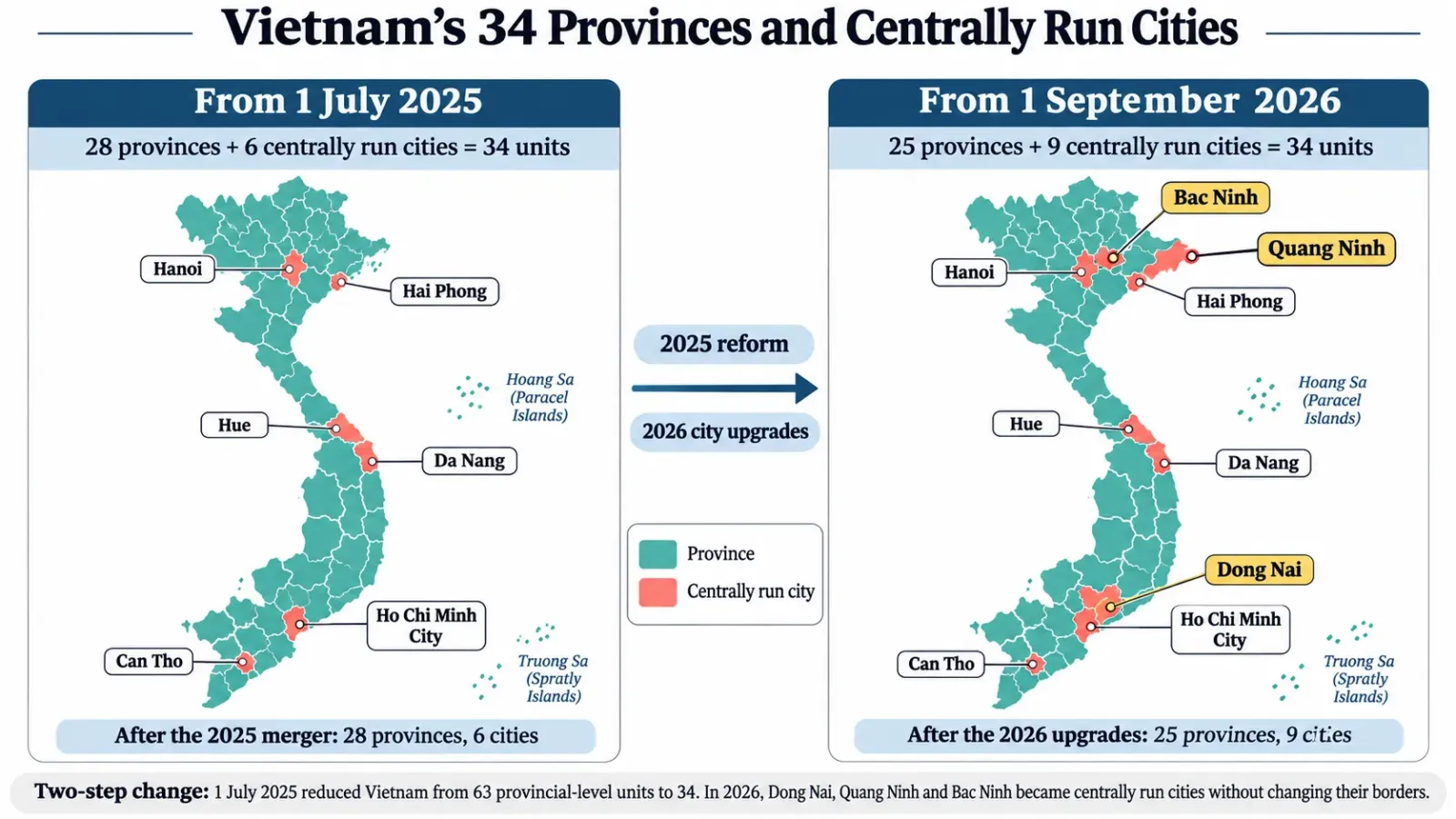
Vietnam's provincial map in two steps: 28 provinces and 6 cities from July 2025, then 25 provinces and 9 cities from September 2026.
What Changed on 1 July 2025
The changes were set out in Resolution 202/2025/QH15, passed by the National Assembly on 12 June 2025. The new provincial governments started work on 1 July 2025, and that is the date most signs, documents and booking systems use as the switch-over.
From 63 Provinces and Cities to 34
Fifty-two former provinces and cities were combined into 23 new units. In almost every case the new unit took the name of one of the provinces that joined it, so the names themselves are familiar. What changed is how much ground each name now covers. Quang Tri, for example, now includes the former Quang Binh province, and Khanh Hoa now includes the former Ninh Thuan.
A few of the new units are much larger than before. Ho Chi Minh City absorbed both Binh Duong and Ba Ria–Vung Tau, and Da Nang absorbed the whole of the former Quang Nam province, including Hoi An.
No More Districts: Provinces Now Go Straight to Wards and Communes
Before July 2025, Vietnam had three tiers of local government: provinces and centrally run cities, then districts, then wards and communes. The district tier has now been abolished, so provinces and cities sit directly above wards, communes and a small number of island special zones. The country reduced its roughly 10,000 commune-level administrative units to 3,321, including communes, wards and special zones. Many were merged and renamed in the process.
This is the change you are most likely to notice in a city address. A hotel that used to give its address as "Ward X, District Y" may now give a new ward name and no district at all.
The 11 That Did Not Merge
Eleven provinces and cities kept their borders in 2025: Hanoi, Hue, Cao Bang, Dien Bien, Ha Tinh, Lai Chau, Lang Son, Nghe An, Quang Ninh, Son La and Thanh Hoa. Quang Ninh, home to Ha Long Bay, has since become a centrally run city, which is covered further down.
Where Popular Destinations Sit Now
This table covers the places international visitors ask about most. The "Before" column shows the province you will find in older guidebooks. The "Now" column shows the province or city as of November 2026.
| Destination | Before July 2025 | Now (November 2026) | Good to know |
|---|---|---|---|
| Hanoi | Hanoi | Hanoi (city) | Not merged |
| Ha Long Bay | Quang Ninh province | Quang Ninh City | Became a city on 1 September 2026; borders unchanged |
| Sa Pa | Lao Cai province | Lao Cai province | Lao Cai now includes the former Yen Bai; Sa Pa is now a ward |
| Ha Giang | Ha Giang province | Tuyen Quang province | The Ha Giang Loop now runs through Tuyen Quang province |
| Ninh Binh (Trang An, Tam Coc) | Ninh Binh province | Ninh Binh province | Now also covers the former Ha Nam and Nam Dinh |
| Tam Chuc Pagoda | Ha Nam province | Ninh Binh province | Now in the same province as Trang An |
| Mai Chau | Hoa Binh province | Phu Tho province | Hoa Binh and Vinh Phuc merged into Phu Tho |
| Hue | Hue (city) | Hue (city) | Not merged |
| Phong Nha | Quang Binh province | Quang Tri province | Now Phong Nha commune |
| DMZ and Vinh Moc Tunnels | Quang Tri province | Quang Tri province | Same name, larger province |
| Da Nang | Da Nang (city) | Da Nang (city) | Now includes the former Quang Nam |
| Hoi An | Quang Nam province | Da Nang (city) | Split into three wards and the island commune of Tan Hiep |
| My Son Sanctuary | Quang Nam province | Da Nang (city) | Same site, new city |
| Cham Islands | Quang Nam province | Da Nang (city) | Now Tan Hiep commune |
| Quy Nhon | Binh Dinh province | Gia Lai province | Binh Dinh merged into Gia Lai |
| Nha Trang | Khanh Hoa province | Khanh Hoa province | Now includes the former Ninh Thuan |
| Vinh Hy Bay and Phan Rang | Ninh Thuan province | Khanh Hoa province | Often still sold as "Ninh Thuan" trips |
| Da Lat | Lam Dong province | Lam Dong province | Now includes the former Dak Nong and Binh Thuan |
| Mui Ne and Phan Thiet | Binh Thuan province | Lam Dong province | Coastal area of the enlarged Lam Dong |
| Ho Chi Minh City | Ho Chi Minh City | Ho Chi Minh City | No districts; see the next section |
| Vung Tau | Ba Ria–Vung Tau province | Ho Chi Minh City | The former city is now several wards |
| Con Dao | Ba Ria–Vung Tau province | Ho Chi Minh City | Now a special zone of the city |
| Cu Chi Tunnels | Cu Chi district, Ho Chi Minh City | Ho Chi Minh City | Ben Dinh is in Nhuan Duc commune; Ben Duoc is in An Nhon Tay commune |
| My Tho and Cai Be | Tien Giang province | Dong Thap province | Tien Giang merged into Dong Thap |
| Ben Tre | Ben Tre province | Vinh Long province | Ben Tre, Tra Vinh and Vinh Long merged |
| Can Tho and Cai Rang | Can Tho (city) | Can Tho (city) | Now includes the former Soc Trang and Hau Giang |
| Chau Doc | An Giang province | An Giang province | Now includes the former Kien Giang |
| Phu Quoc | Kien Giang province | An Giang province | Now a special zone of An Giang |
Northern Vietnam
The north saw some of the biggest mergers, but its best-known destinations kept their names. Hanoi was not merged at all. The landscapes around Ninh Binh now share a province with Tam Chuc Pagoda and the former Nam Dinh coast, which can make a two-day trip there feel more joined up on a map. In the far north, Ha Giang has become part of Tuyen Quang, and Sa Pa sits in a Lao Cai province that now stretches south to the former Yen Bai. See our Northern Vietnam page for trips across the region.
Central Vietnam
Two changes matter most in the centre. First, Quang Binh merged into Quang Tri, so Phong Nha and its caves are now listed under Quang Tri, the same province as the former DMZ. That is why our guides to visiting the DMZ from Hue and choosing between Paradise, Phong Nha and Dark Cave now name the same province.
Second, the former Quang Nam province became part of Da Nang. Hoi An is now administered by Da Nang City, which is why its heritage fees are set by Da Nang; our Hoi An Ancient Town ticket guide explains what that means at the ticket booth.
Further south, Nha Trang keeps its Khanh Hoa address, but the province now includes the vineyards and bays of the former Ninh Thuan. Our Central Vietnam page covers the whole stretch from Hue to the south-central coast.

Hoi An now belongs to Da Nang City, but the UNESCO-listed Ancient Town keeps its name.
Southern Vietnam and the Mekong Delta
Across the south-west, thirteen former provinces and cities were folded into six, one of which, Tay Ninh, now also covers the former Long An. My Tho and Cai Be are now in Dong Thap, Ben Tre is part of Vinh Long, Can Tho City has grown to include the former Soc Trang and Hau Giang, and Chau Doc lies in an enlarged An Giang that now also covers Phu Quoc. Tours, menus and souvenir shops still use the old names, so you will see "Ben Tre coconut candy" long after Ben Tre stopped being a province. Our guide to choosing a Mekong Delta day trip or overnight has a short note on the delta's new names, and our Mekong Delta page covers the region as a whole.
If you are browsing by town, our pages for My Tho, Tien Giang, Ben Tre, Dong Thap, Vinh Long, Can Tho and Chau Doc keep the names travellers search for. For everything south of the centre, start with our Southern Vietnam page.
Ho Chi Minh City Without Districts
Ho Chi Minh City went through one of the biggest changes. It merged with Binh Duong and Ba Ria–Vung Tau to become a city of about 6,770 square kilometres and roughly 14 million people. All of its districts, including the famous numbered ones, were abolished. The enlarged city now has 168 units below city level: 113 wards, 54 communes and one special zone.
What Happened to District 1
The old District 1 was split between four new wards:
- Saigon Ward (phường Sài Gòn): around the Opera House, Dong Khoi and the riverside
- Ben Thanh Ward (phường Bến Thành): Ben Thanh Market and the Pham Ngu Lao backpacker area
- Tan Dinh Ward (phường Tân Định): the north of the old district, around Tan Dinh Church
- Cau Ong Lanh Ward (phường Cầu Ông Lãnh): the southern edge towards the canal
Drivers, hotels and tour operators, including us, still say "District 1", and everyone understands it. Where it matters is in written addresses and pickup rules. Some tours on our site pick up from hotels in the former District 1 but list particular wards as exceptions, so compare the ward on your hotel booking with the pickup policy before you book. Our 3-day Ho Chi Minh City itinerary covers getting around the centre, and our Ho Chi Minh City page lists tours that start there.
Vung Tau, Binh Duong and Con Dao Are Now Part of the City
Vung Tau still feels like a separate seaside town, but it is now administratively part of Ho Chi Minh City, and the former city has been reorganised into several wards, including Vung Tau Ward. The Con Dao islands, also formerly part of Ba Ria–Vung Tau, are now a special zone of Ho Chi Minh City. Binh Duong, the industrial province to the north, has been absorbed as well. In practice this means you may see "Ho Chi Minh City" on a Vung Tau or Con Dao hotel address.
Cu Chi Tunnels: New Commune Names
The former Cu Chi district has become seven communes. The Ben Dinh tunnel site is in Nhuan Duc commune and Ben Duoc is in An Nhon Tay commune, both still in Ho Chi Minh City. Older maps and tour descriptions may still say "Cu Chi District". Our guide to Ben Dinh vs Ben Duoc explains how the two sites differ, and our Cu Chi Tunnels page lists the tours that go there.
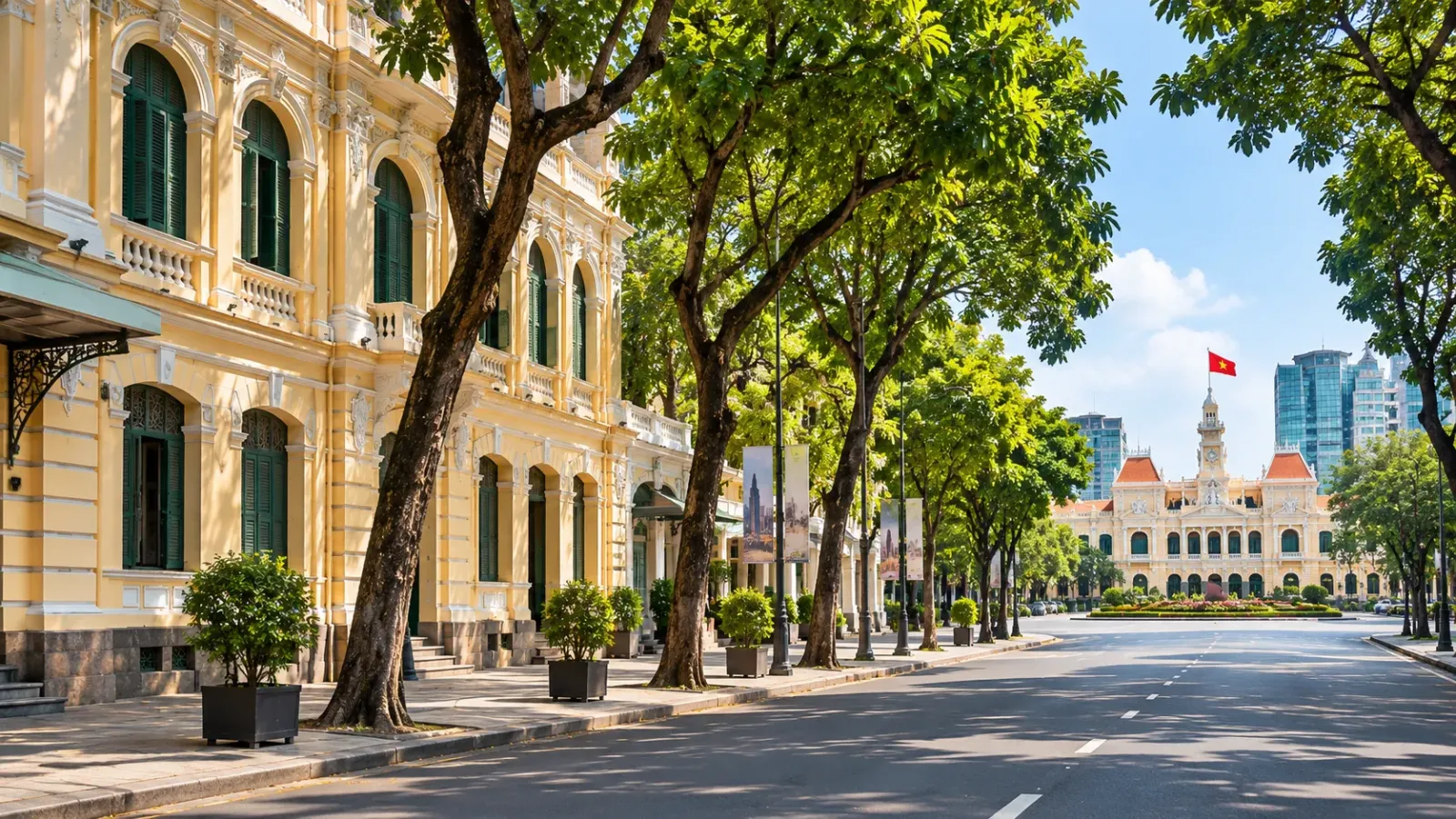
The old District 1 is now four wards, though drivers and hotels still use the district name.
What Changed Again in 2026
The number of provincial-level units stayed at 34 in 2026, but three provinces were upgraded to centrally run cities on their existing borders:
- Dong Nai became a city on 30 April 2026 (National Assembly Resolution 30/2026/QH16).
- Quang Ninh became a city on 1 September 2026 (National Assembly Resolution 36/2026/QH16).
- Bac Ninh became a city on 20 September 2026 (National Assembly Resolution 39/2026/QH16).
That brings the number of centrally run cities to nine: Hanoi, Ho Chi Minh City, Hai Phong, Da Nang, Can Tho, Hue, Dong Nai, Quang Ninh and Bac Ninh. The remaining 25 units are provinces.
The one that matters most to visitors is Quang Ninh. Ha Long Bay is now in Quang Ninh City rather than Quang Ninh province. Nothing changes about the bay, the harbours or the cruise routes. If you are still deciding how to see it, our guide to a Ha Long Bay day trip or overnight cruise compares the options.
Vietnam's Ministry of Home Affairs has said there are no plans for further mergers of provinces or communes. Other provinces have stated goals of becoming centrally run cities later in the decade, so more name changes of this kind are possible. If you read this guide much later than November 2026, check the latest status before relying on it for an official address.

Ha Long Bay has been part of Quang Ninh City since the province became a centrally run city in September 2026.
What It Means for Your Trip
For most visitors the merger is a reading exercise rather than a practical problem. Three situations are worth knowing about.
Addresses, Hotel Bookings and Pickups
The same hotel may appear with an old address on one booking site and a new one on another, or with the old district and the new ward mixed together. Both usually lead to the same door. When you need to give an address, for a taxi or a tour pickup, use the one on your hotel confirmation, and if a tour lists pickup areas by ward, check which ward your hotel is now in. If in doubt, ask the hotel.
Maps and Apps
Google Maps began showing the new administrative boundaries in March 2026, more than eight months after the merger. Other apps, printed maps and guidebooks may still show the old provinces, and some show a mix. Searching for the place itself, such as "Phong Nha Cave" or "Hoi An Ancient Town", works far better than searching by province.
Signs, Tickets and Tour Names
Road signs, official notices and receipts are gradually switching to the new names, while tours, restaurants and souvenirs tend to keep the old ones because travellers recognise them. You will still see "Ninh Thuan" on day trips from Nha Trang, "Ben Tre" on coconut boat rides and "District 1" in pickup notes, including on our own site. These familiar names are still the easiest way to search for destinations and tours, even where they no longer match a current province. For an official address, use the updated province or city and the ward or commune name.
What Hasn't Changed
Vietnam's Ministry of Culture, Sports and Tourism asked provinces to keep the names of World Heritage sites, special national relics and national tourist areas exactly as they were recognised. "Hoi An Ancient Town", "Phong Nha–Ke Bang National Park" and "Ha Long Bay" therefore remain the names you will see at the sites themselves.
Hanoi and Hue were not merged at all. The reform did not move any attraction or change the distances between them, and the seasons are the same, so the advice in our guide to the best time to visit Vietnam and our two-week Vietnam itinerary still applies. Journey times still depend on traffic, roadworks, weather and transport schedules, so check current conditions as you plan.
All 34 Provinces and Cities at a Glance
This list shows every provincial-level unit as of November 2026, with the former provinces or cities each one was formed from. Units marked "not merged" kept their 2025 borders.
| Province or city now | Type | Formed from |
|---|---|---|
| Hanoi | City | Not merged |
| Ho Chi Minh City | City | Ho Chi Minh City, Ba Ria–Vung Tau, Binh Duong |
| Hai Phong | City | Hai Phong, Hai Duong |
| Da Nang | City | Da Nang, Quang Nam |
| Can Tho | City | Can Tho, Soc Trang, Hau Giang |
| Hue | City | Not merged |
| Dong Nai | City (since 30 April 2026) | Dong Nai, Binh Phuoc |
| Quang Ninh | City (since 1 September 2026) | Not merged |
| Bac Ninh | City (since 20 September 2026) | Bac Ninh, Bac Giang |
| Cao Bang | Province | Not merged |
| Dien Bien | Province | Not merged |
| Lai Chau | Province | Not merged |
| Lang Son | Province | Not merged |
| Son La | Province | Not merged |
| Tuyen Quang | Province | Tuyen Quang, Ha Giang |
| Lao Cai | Province | Lao Cai, Yen Bai |
| Thai Nguyen | Province | Thai Nguyen, Bac Kan |
| Phu Tho | Province | Phu Tho, Vinh Phuc, Hoa Binh |
| Hung Yen | Province | Hung Yen, Thai Binh |
| Ninh Binh | Province | Ninh Binh, Ha Nam, Nam Dinh |
| Thanh Hoa | Province | Not merged |
| Nghe An | Province | Not merged |
| Ha Tinh | Province | Not merged |
| Quang Tri | Province | Quang Tri, Quang Binh |
| Quang Ngai | Province | Quang Ngai, Kon Tum |
| Gia Lai | Province | Gia Lai, Binh Dinh |
| Dak Lak | Province | Dak Lak, Phu Yen |
| Khanh Hoa | Province | Khanh Hoa, Ninh Thuan |
| Lam Dong | Province | Lam Dong, Dak Nong, Binh Thuan |
| Tay Ninh | Province | Tay Ninh, Long An |
| Dong Thap | Province | Dong Thap, Tien Giang |
| Vinh Long | Province | Vinh Long, Ben Tre, Tra Vinh |
| An Giang | Province | An Giang, Kien Giang |
| Ca Mau | Province | Ca Mau, Bac Lieu |
Frequently Asked Questions
Is Hoi An still called Hoi An?
Yes. Hoi An is no longer a separate city: it is now part of Da Nang City and has been divided into three wards, all with "Hoi An" in their names, plus the island commune of Tan Hiep. The UNESCO-listed Hoi An Ancient Town keeps its name.
Is Vung Tau part of Ho Chi Minh City now?
Yes. Since 1 July 2025 the former Ba Ria–Vung Tau province, including Vung Tau and the Con Dao islands, has been part of Ho Chi Minh City. The beaches and the journey there are the same; only the address has changed.
Which province is Phong Nha in?
Phong Nha is now in Quang Tri province, which absorbed the former Quang Binh province. The area is now Phong Nha commune, and Phong Nha–Ke Bang National Park keeps its name.
Does "District 1" still exist?
Not officially. Ho Chi Minh City abolished all districts on 1 July 2025, and the old District 1 is now Saigon, Ben Thanh, Tan Dinh and Cau Ong Lanh wards. Everyone still uses "District 1" in conversation.
Is Ha Long Bay in a province or a city now?
A city. Quang Ninh became a centrally run city on 1 September 2026, so Ha Long Bay is now in Quang Ninh City. The bay itself is unchanged.
Will my hotel address or booking still work?
In almost all cases, yes. Old and new addresses point to the same place. Use the address on your hotel confirmation, and check the ward name if a tour lists pickup areas by ward.
Will more provinces merge?
The Ministry of Home Affairs has said there are no plans for further mergers. Some provinces may still become centrally run cities in future, as Dong Nai, Quang Ninh and Bac Ninh did in 2026, which changes their title but not their borders.
Plan Your Route Across the New Map
The new map changes the labels, not the journey. If you are planning several regions, start with where to go in Vietnam or browse our Vietnam tours by destination. If you would rather have a route planned around your dates, our team can build a private itinerary for you.
Related articles

Best Time to Visit Vietnam: A Month-by-Month Guide to the North, Centre and South
Central Vietnam Flood & Typhoon Season: When It Happens and How to Plan Your Trip

Tet 2027 in Vietnam: Dates, What's Open and How to Plan Your Trip

Nha Trang Island Hopping 2026–27: Which Islands, Which Boat and What to Expect Now

Hue to Hoi An via the Hai Van Pass: How to Make the Trip and What You’ll See

Visiting the DMZ from Hue: Which Sites to See and How to Plan Your Day Trip

3 Days in Ho Chi Minh City: A Day-by-Day Itinerary for First-Time Visitors