What to Eat in Hue: Royal Dishes, Street Food and Where to Try Them
Vietnam Travel TipsBy Pham Phuong Anh
Hue cooks differently from the rest of Vietnam: smaller plates, more chilli and a court tradition behind many everyday dishes. This guide explains what to order, from bun bo Hue and com hen to royal-style banquets and vegetarian food, and which markets, streets and neighbourhoods to head for.
Table of contents
Hue Food at a Glance
Hue was the seat of the Nguyen emperors from 1802 to 1945, and its culinary traditions still reflect that imperial past: many small dishes, careful presentation and plenty of chilli. If you only have a day or two, start with the dishes below.
| Dish | What it is | Best time | Common ingredients and allergens |
|---|---|---|---|
| Bun bo Hue | Spicy beef noodle soup with lemongrass | Breakfast | Beef, often pork, shrimp paste; some versions contain crab |
| Com hen | Rice tossed with baby clams, herbs and crunchy toppings, with clam broth on the side | Morning | Clams, peanuts, shrimp paste, often pork crackling |
| Banh beo, banh nam, banh bot loc | Three small steamed rice or tapioca cakes with shrimp | Mid-afternoon snack | Shrimp, fish sauce, sometimes pork |
| Banh khoai | Crisp turmeric pancake filled with shrimp, pork and bean sprouts | Lunch or dinner | Shrimp, pork, egg; dipping sauce often contains peanuts and pork liver |
| Nem lui | Pork grilled on lemongrass stalks, rolled in rice paper | Lunch or dinner | Pork; dipping sauce may contain peanuts, sesame, fish or shrimp-based seasonings |
| Che | Sweet soups and puddings, served warm or over ice | Afternoon and evening | Ingredients vary; some contain peanuts, coconut, dairy or pork |
| Royal-style banquet | A multi-course dinner modelled on court cuisine | Dinner, booked ahead | Varies by menu and restaurant |
These are typical ingredients rather than a complete allergen list. Recipes and dipping sauces vary between kitchens, so always confirm ingredients and preparation methods if you have a food allergy or dietary restriction.
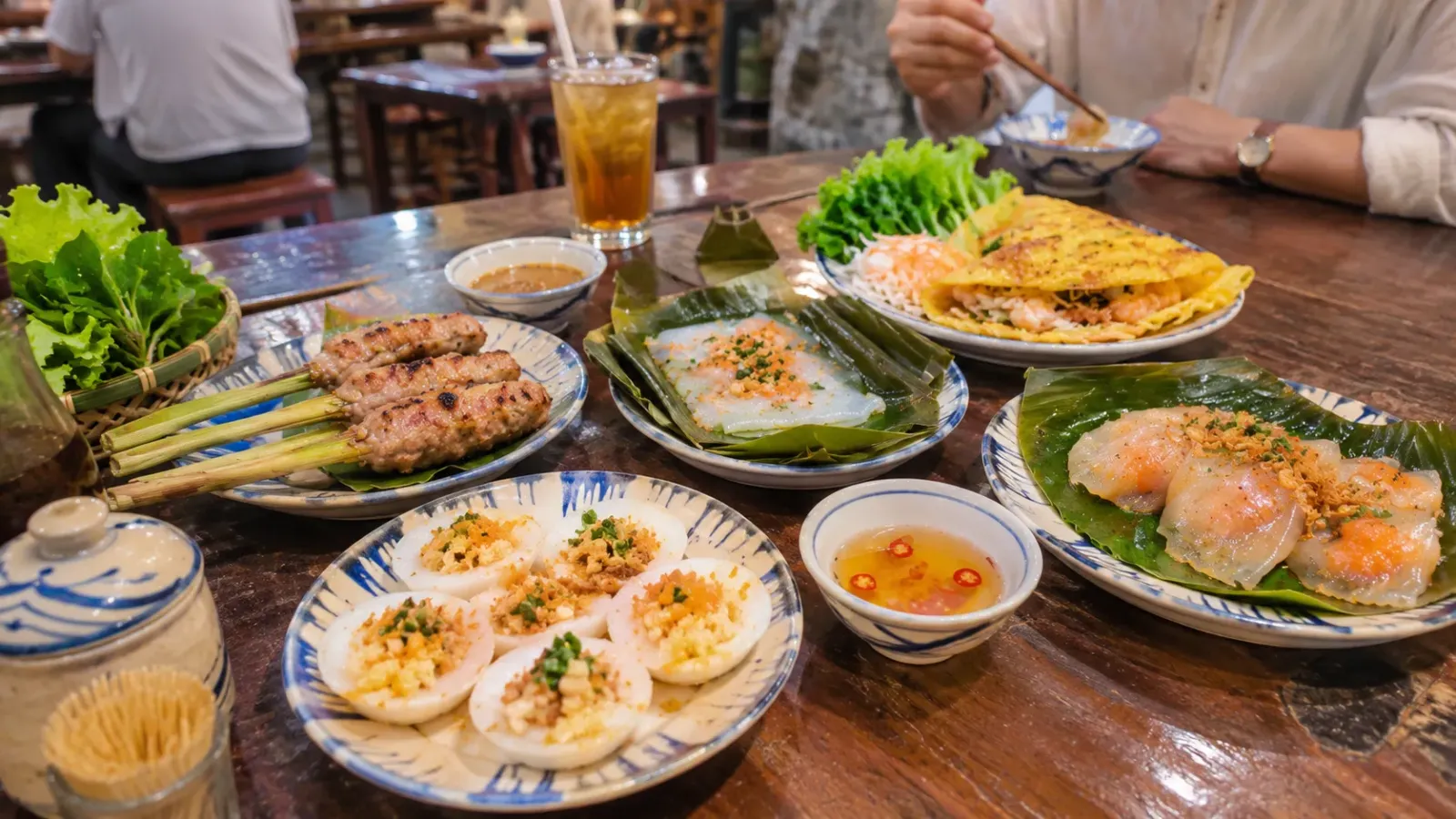
A Hue meal is usually built from several small dishes rather than one large plate.
Why Hue Food Tastes Different
Three things shaped the way Hue cooks. The first is the court. Under the Nguyen dynasty, royal kitchens followed strict rules on ingredients, technique, table setting and service, and that habit of care spread beyond the palace walls. Even a street snack here tends to arrive in a small portion, neatly garnished.
The second is seasoning. Hue cooks lean on chilli, lemongrass and mam ruoc, a fermented shrimp paste that gives bun bo Hue and com hen their depth. Many dishes are noticeably spicy. Fresh chilli is often served on the side, but some broths and sauces are already seasoned with it before they reach the table.
The third is Buddhism. Many families in Hue eat vegetarian food on set days each lunar month, and the city has a meat-free cooking tradition of its own. That makes Hue one of the easier places in Vietnam for vegetarians to eat well.
Hue's culinary heritage is also receiving wider recognition. On 27 June 2025, folk knowledge associated with bun bo Hue was added to Vietnam's national intangible cultural heritage list. Hue is also preparing an application for UNESCO's Creative Cities Network in gastronomy, with submission planned for 2027.
Royal Dishes: What the Court Ate and What You Can Try Today
What court cuisine was
Royal cuisine in Hue reached its most refined form under the Nguyen emperors. Vietnam's state news agency describes court cooking as favouring a gentler, more delicate profile than everyday food, with little oil and nothing too sweet or too salty, and dishes had to please the eye as much as the palate. Two of the best-known examples are nem cong and cha phuong, dishes associated with the elaborate peacock and phoenix imagery of royal banquets. Modern interpretations often use more familiar ingredients and retain the decorative presentation rather than reproduce the original recipes.
The scale was considerable. According to VisitHue, the city's official tourism portal, the emperor's breakfast had 12 dishes, and lunch and dinner each had 50 savoury and 16 sweet dishes. The most prized banquet dishes, known as the eight treasures, were built around rare ingredients such as bear's paw and deer tendon. Those belong to the historical record rather than to modern menus.
A royal-style dinner today
What you can book now is a re-creation. Several restaurants in Hue serve multi-course "royal" set menus, sometimes with staff in court dress and live court music, and some invite guests to wear Nguyen-style robes for photos. The recipes are kept alive by descendants of the royal family and of palace cooks, but Vietnamese food writers are open about the fact that modern versions are not always faithful to the originals.
Treat it as an evening of theatre with good food, and it is enjoyable. Expect carved vegetables, small portions over many courses and a set price well above what street food costs. Two options listed by Hue's tourism portal are Tinh Gia Vien, a garden house at 7/28 Le Thanh Ton inside the Citadel walls, and Ancient Hue at 104/47 Kim Long, west of the Citadel. Book ahead through your hotel, and check that the restaurant is operating before you go.
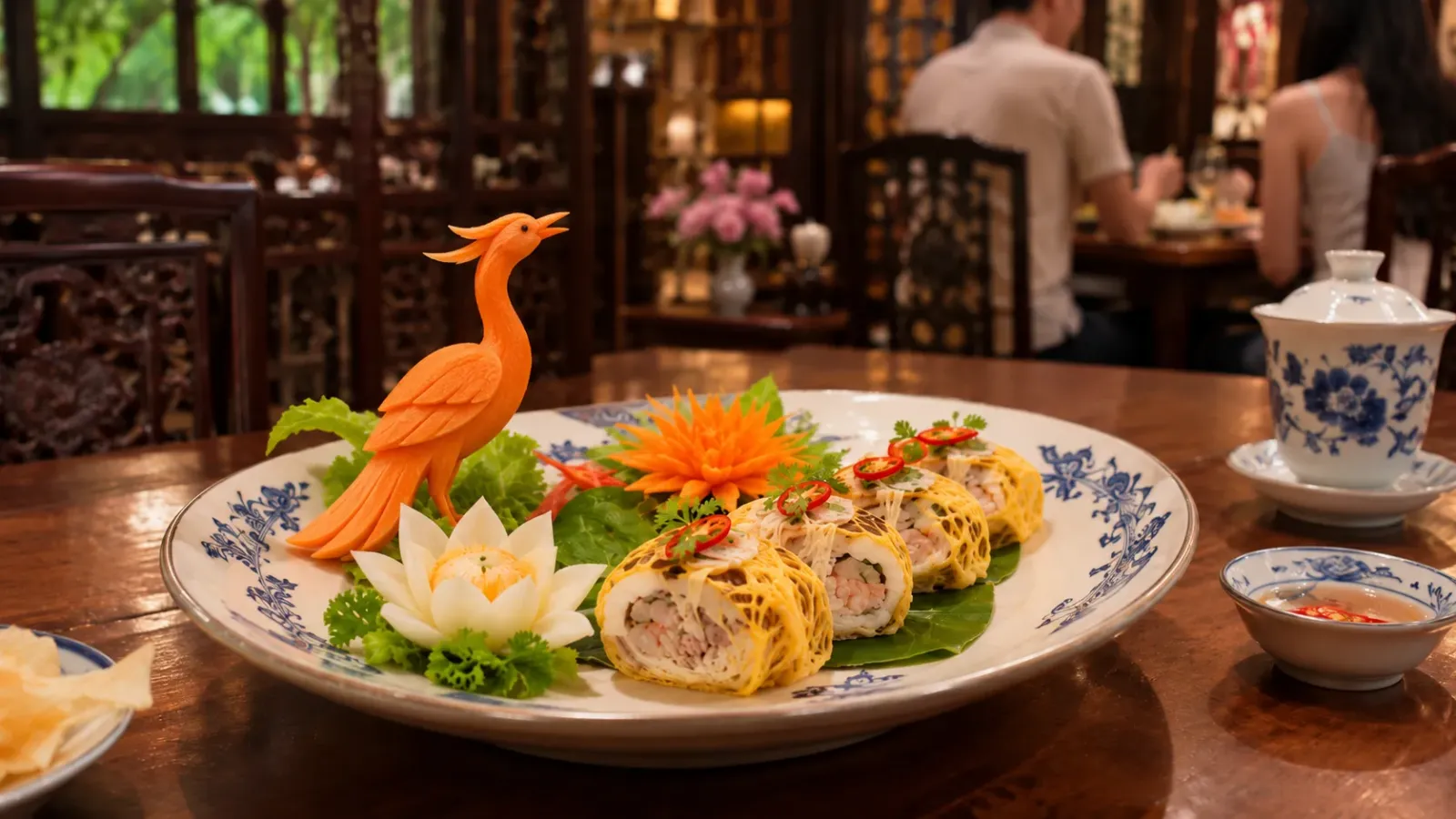
Royal-style menus in Hue today are modern re-creations, known as much for presentation as for flavour.
Court-linked dishes on every street
You do not need a banquet to taste the court's influence. Some of Hue's sweet soups were once served as desserts to the royal family, and che is now sold from carts and small shops all over the city. Local tradition also holds that the baby clams gathered around Con Hen islet in the Perfume River were once sent to the palace kitchens, although that is a story passed down by residents rather than a documented fact. Both che and clam rice are now among the cheapest things to eat in Hue.
Street Food and Local Drinks You Should Try
Bun bo Hue
This is the dish that carries the city's name. The broth is made from beef bones, lemongrass, shrimp paste and chilli oil, and it balances spicy, sour, salty and savoury in one bowl. It is traditionally served with thick, round rice noodles, sliced beef and fresh herbs. Over time, toppings such as pork knuckle, crab cakes and cubes of blood jelly have become common, so ask what is in the bowl if there is anything you avoid.
Bun bo Hue is traditionally a breakfast dish, so go early; popular stalls can run out before lunch. Add the herbs a handful at a time, squeeze in lime, and taste the broth before you reach for more chilli.
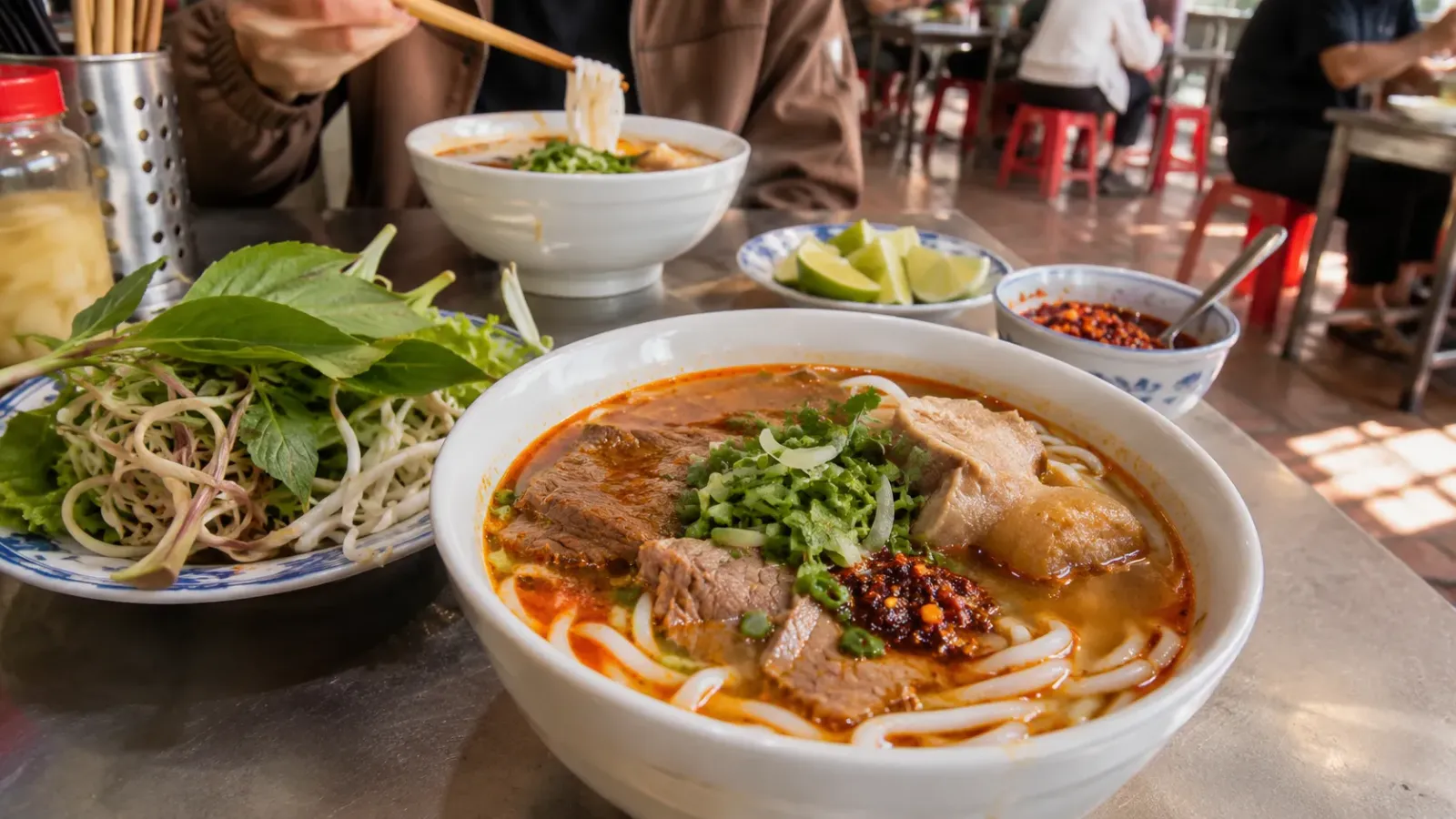
Bun bo Hue is traditionally eaten for breakfast, with herbs, lime and extra chilli served on the side.
Com hen and bun hen
Com hen is Hue's most distinctive everyday dish. Rice is tossed with tiny river clams, roasted peanuts, pork crackling, crisp rice crackers, shredded banana flower, star fruit, herbs and chilli, and a bowl of hot clam broth comes alongside. The mix is salty, sour, crunchy and spicy at once. Bun hen is the same idea with rice vermicelli in place of rice.
Vy Da, the neighbourhood facing Con Hen islet, is one of the best-known areas for trying it. Com Hen Hoa Dong at 64 Kiet 7 Ung Binh and the clam-rice shops along Han Mac Tu Street are the names that come up most often.
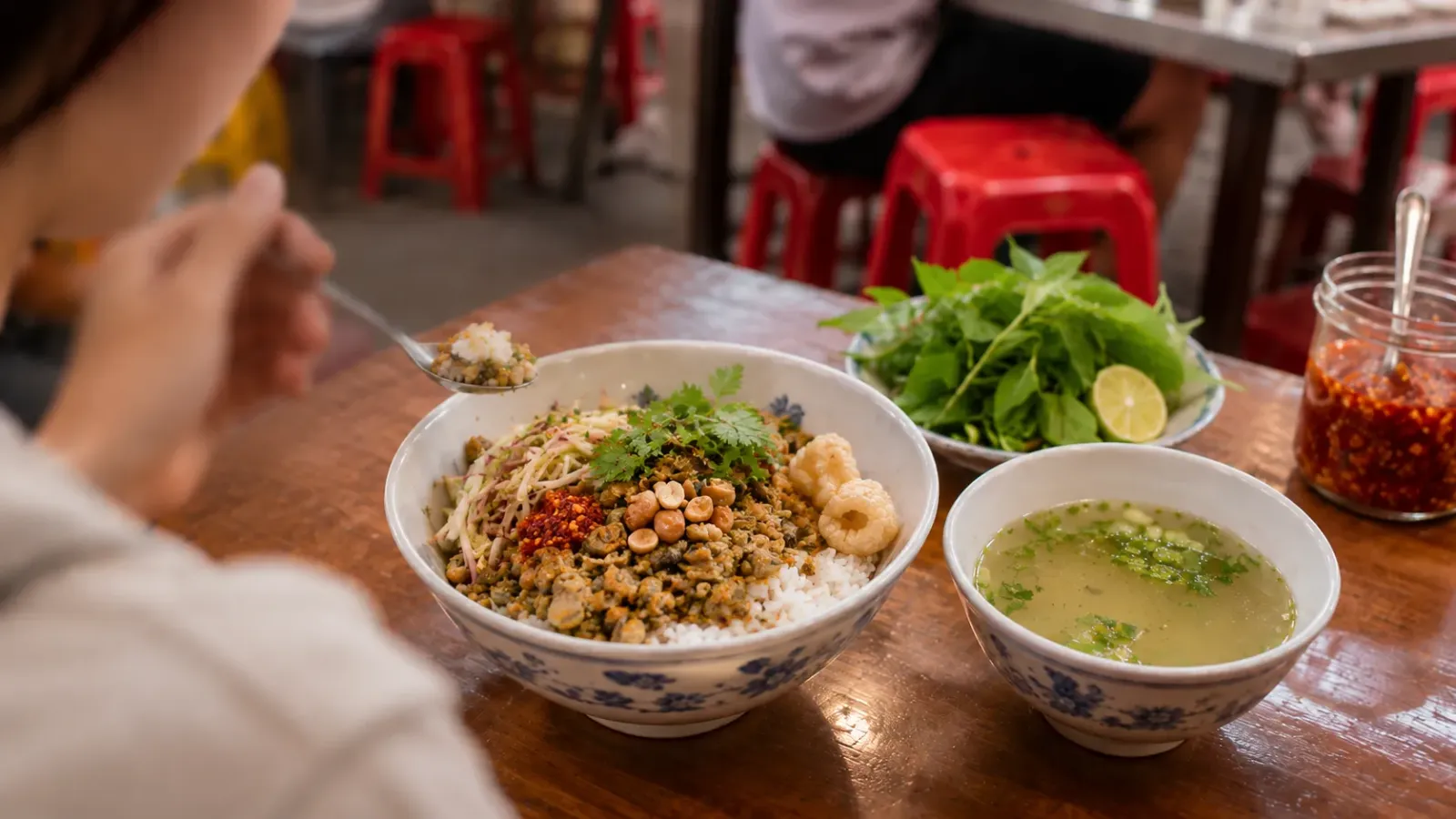
Com hen always arrives with a separate bowl of hot clam broth to sip or pour over the rice.
Banh beo, banh nam and banh bot loc
These three steamed cakes are usually ordered together.
- Banh beo are small rice cakes steamed in individual saucers and topped with dried shrimp, pork crackling and scallion oil. Spoon on a little sweetened fish sauce and scoop each one out.
- Banh nam is a flat rice-flour dumpling with shrimp, steamed in a banana leaf. Unfold the leaf and eat it straight off the surface.
- Banh bot loc is a chewy, translucent tapioca dumpling with shrimp and pork inside. Its dipping sauce is saltier than the one for banh beo, so use less.
Ba Do at 8 Nguyen Binh Khiem, on the north bank east of the Citadel, is a long-running choice for all three. In Kim Long, O Le is at 104/17/9 Kim Long, down a lane off the main road.
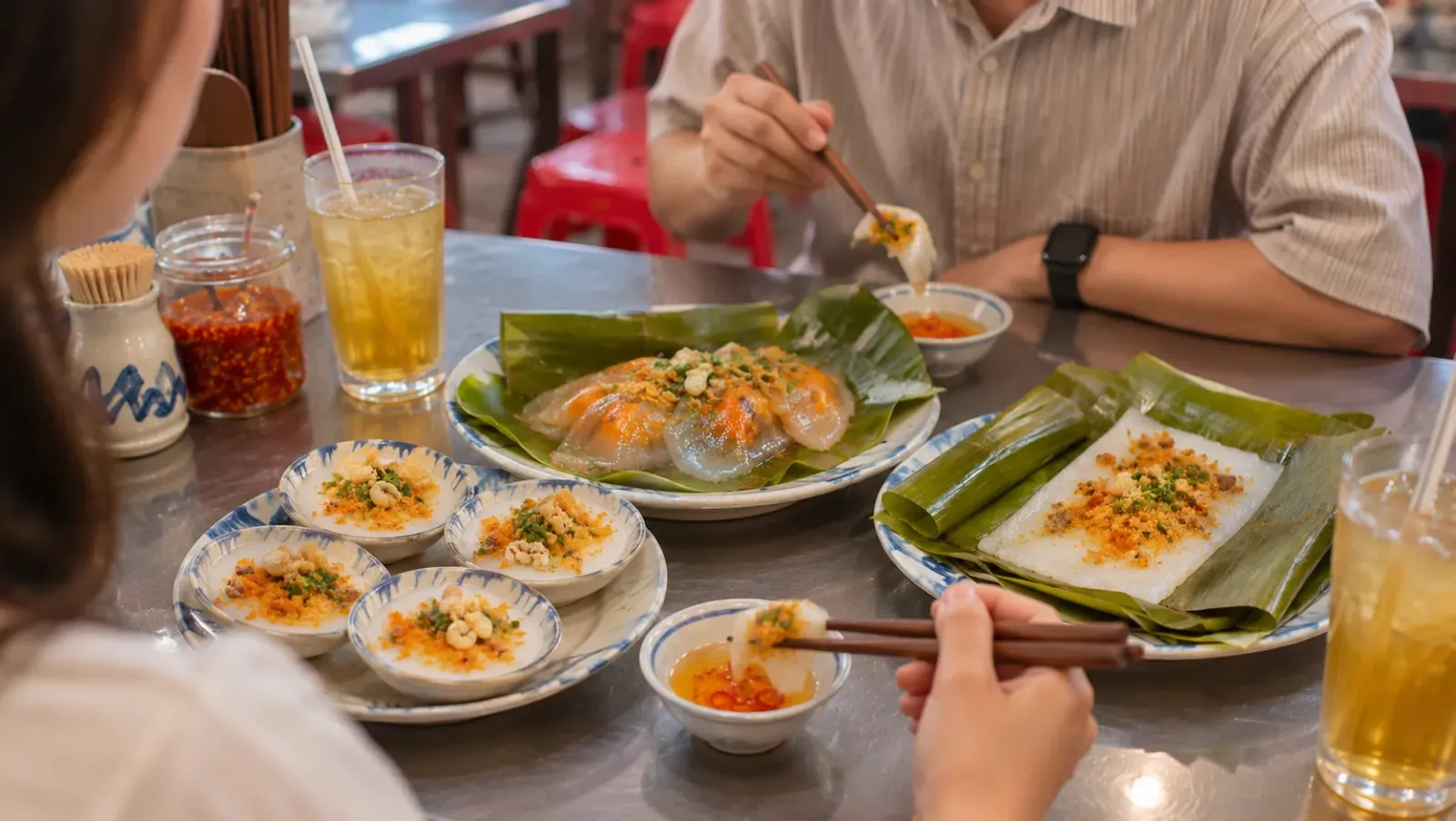
Banh beo, banh nam and banh bot loc are usually ordered together as a mid-afternoon snack.
Banh khoai and nem lui
Banh khoai is a thick, crisp pancake made from rice flour and turmeric, fried with shrimp, pork belly, quail egg and bean sprouts. It comes with a plate of herbs, sliced fig and star fruit, and a rich brown dipping sauce traditionally made with peanuts and pork liver. Nem lui, its usual partner, is seasoned pork pressed around lemongrass stalks and grilled over charcoal. Slide the meat off the stalk, wrap it in rice paper with herbs, and dip it in a similar peanut-based sauce.
Lac Thien at 6 Dinh Tien Hoang, beside the Citadel's Thuong Tu Gate, and Quan Hanh at 11 Pho Duc Chinh on the south bank are both known for the pair. Banh Khoai Thu Suong at 86 Kim Long is another option.
Banh uot, bun thit nuong and banh ram it
Three more dishes are worth ordering if you see them. Banh uot is a soft sheet of fresh rice noodle rolled around herbs and grilled meat. Bun thit nuong is charcoal-grilled pork over cool rice vermicelli with herbs and pickles, served with a light fish sauce or a rich peanut-based dressing, depending on the restaurant. Banh ram it sets a soft sticky-rice dumpling on top of a crisp fried one. Huyen Anh on Kim Long Street specialises in the first two.
More to look for
Banh canh Nam Pho is a bowl of thick, translucent noodles topped with crab and shrimp, and a good alternative when you want a soup that is not bun bo. Com am phu, which translates loosely as "underworld rice", is a colourful plate of rice with shredded grilled pork, shrimp, egg and herbs that suits a quick lunch; several stories explain the name, and none is confirmed. Me xung, a chewy sesame and peanut candy, is the classic edible souvenir.
Che
Hue has dozens of sweet soups, made from lotus seeds, beans, taro, corn and more. The one to try for the story alone is che bot loc heo quay: tapioca pearls with a small piece of sweet-salty roast pork inside, served in ginger syrup. The combination creates an unusual contrast between savoury pork and sweet ginger syrup. Che Hem, down lane 29 off Hung Vuong Street, is a popular place to work through a few glasses.
Salt coffee (ca phe muoi)
Hue is the home of salt coffee, a local variation of Vietnamese coffee topped with a layer of lightly salted cream. The salt softens the bitterness of the coffee and balances the sweetness of the condensed milk. Try it between meals or during an afternoon break at a local cafe.
Vegetarian Food in Hue
Hue's vegetarian cooking grew from two sources: elaborate meat-free dishes developed for the court, and the plainer food of Buddhist monasteries. Many Buddhists here still eat vegetarian on the first and fifteenth days of each lunar month, when restaurants across the city put meat-free dishes on the menu. The city also holds a vegetarian food festival; the third edition took place on 28 and 29 May 2026 on Nguyen Dinh Chieu walking street.
Look for places with chay on the sign, which means vegetarian. Their menus often include meat-free takes on local classics, such as a vegetarian bun bo Hue made with a mushroom-based broth, along with rice plates, tofu and mushroom dishes, and vegetarian versions of the steamed rice cakes.
In ordinary restaurants, be aware that fish sauce and shrimp paste are in most sauces and many broths. Vegetarian does not automatically mean vegan, as egg and dairy can appear in some dishes, and it does not mean allergen-free, since peanuts, sesame and soy are widely used. If you are strict, a dedicated vegetarian restaurant is the safer choice.
Where to Try Them: Hue by Area
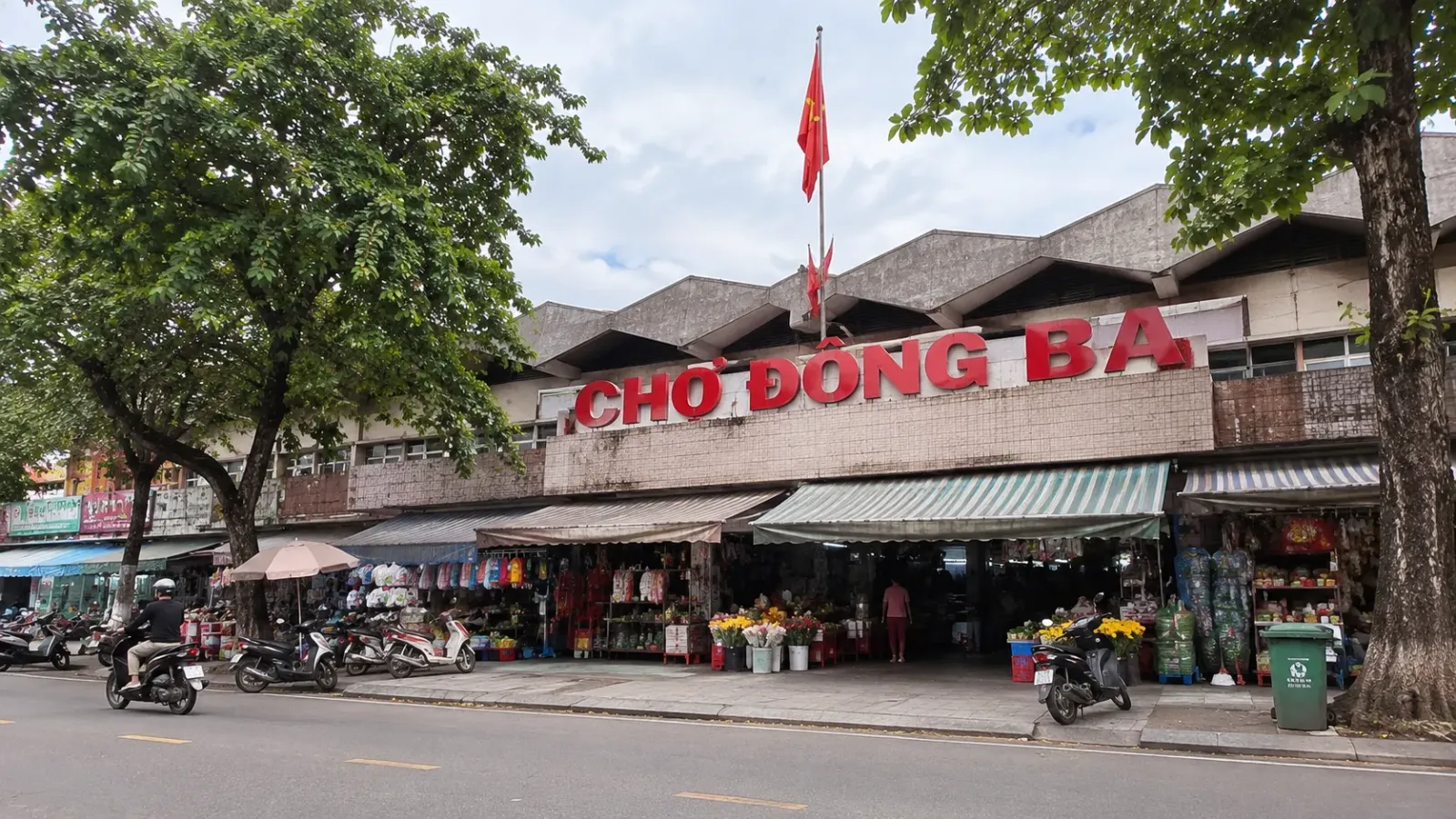
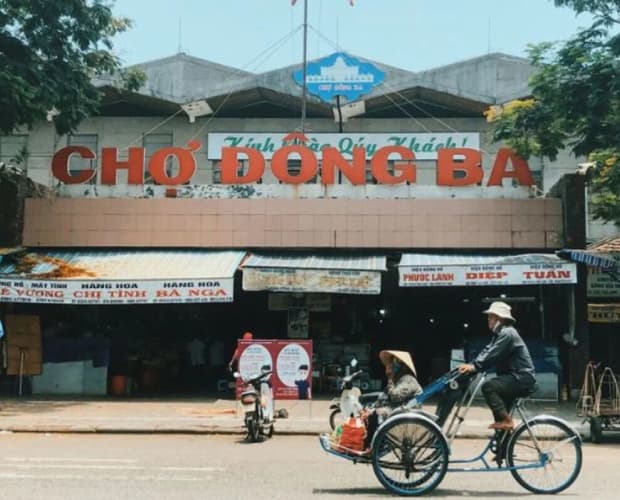
Dong Ba Market on the north bank is the easiest single place to sample several Hue dishes in one morning.
Restaurants open, move and close, so use the names in this guide as starting points and confirm that a place is open before you cross town for it.
Dong Ba Market and the north bank
Dong Ba, at 2 Tran Hung Dao, is Hue's biggest market and a short walk from Truong Tien Bridge. The ground floor has a food court where stalls surround shared seating, selling bun bo Hue, banh beo, com hen and che. It is at its best in the morning, and many food stalls wind down after lunch. In the evening, food stalls traditionally set up in front of the market from around 6 pm, as daytime vendors begin to close. Opening times and the number of stalls can vary.
Around the Citadel
If you are spending the day at the Imperial City, you can eat without leaving the area. Lac Thien is by Thuong Tu Gate, and Tinh Gia Vien is inside the walls. For tickets and a sensible route through the palace, see our guide to Hue Imperial City and royal tomb tickets.
Kim Long
Kim Long is the riverside road that runs west from the Citadel towards Thien Mu Pagoda. It has a cluster of family-run places for steamed cakes, banh uot and banh khoai, including O Le, Huyen Anh and Thu Suong, and it combines well with a pagoda visit.
Vy Da and Con Hen
East of the centre, Vy Da is the area most closely associated with com hen and bun hen. Go in the morning.
The south bank after dark
Most hotels are on the south bank, and so is most of the evening eating. The walking streets of the backpacker quarter fill with stalls and outdoor tables from about 7 pm, Truong Dinh Street runs as a night food street, and Quan Hanh and Che Hem are both in the central part of the south bank.
When to Eat What
| Time of day | What to look for | Where |
|---|---|---|
| Early morning | Bun bo Hue, com hen | Dong Ba Market, Vy Da, street stalls |
| Lunch | Banh khoai, nem lui, bun thit nuong, com am phu | Around the Citadel, Kim Long, south bank |
| Mid-afternoon | Banh beo, banh nam, banh bot loc, che, salt coffee | North bank, Kim Long, south bank |
| Evening | Royal-style dinner, or night-market grazing and che | Citadel, Kim Long, Dong Ba, south-bank walking streets |
If Hue is one stop on a longer route, our Central Vietnam itinerary shows how the city fits with Hoi An and Da Nang.
How to Order: Spice, Allergies and Paying
- Spice. Ask for your food not spicy or a little spicy before you order, using the phrases below. Fresh and pickled chilli are usually on the table, but some broths and dipping sauces are seasoned in advance, so a request for no chilli does not guarantee a dish with no heat at all.
- Peanuts. The dipping sauces for nem lui and banh khoai are usually peanut-based, bun thit nuong may come with a peanut dressing, peanuts are sprinkled over com hen and some che, and me xung candy is made with them. If you have an allergy, avoid these dishes rather than asking for the sauce on the side.
- Shellfish. Dried shrimp, fresh shrimp and shrimp paste appear in most of the dishes above, including the bun bo Hue broth.
- Offal. The traditional banh khoai sauce contains pork liver, and bun bo Hue may come with blood jelly.
- Paying. Street stalls and market counters generally expect cash in small notes. For cards, QR payments and tipping, see our guide to money in Vietnam.
If you have a serious food allergy, carry a written allergy card in Vietnamese. Sauces, broths, cooking utensils and frying oil may be shared between dishes. If a restaurant cannot confirm that your food can be prepared safely, choose another place rather than relying on a verbal assurance alone.
These phrases cover most situations. You can also show the Vietnamese text on your screen. They help with ordering, but they do not replace confirming that a dish is safe for an allergy.
| Vietnamese | English |
|---|---|
| Không cay | Not spicy |
| Ít cay | A little spicy |
| Không nước mắm | No fish sauce |
| Không mắm ruốc | No fermented shrimp paste |
| Tôi ăn chay | I am vegetarian |
| Tôi bị dị ứng đậu phộng | I am allergic to peanuts |
| Món này có tôm không? | Does this dish contain shrimp? |
| Bao nhiêu tiền? | How much does it cost? |
Most small places specialise in one or two dishes. Sit down and point at what the next table is eating. This can be an easy way to discover a stall's speciality.
Trying Hue Food with a Guide
If you would rather have someone lead the way, our Hue Half-Day Walking Food Tour covers the street-food classics on foot in four hours. The route crosses Truong Tien Bridge to Dong Ba Market and continues to local food shops, with tastings that include banh beo, banh bot loc, nem lui and banh khoai, a choice of bun bo Hue or bun thit nuong, che, and a coffee or another drink. You choose one of three sessions: morning from 09:00 to 13:00, afternoon from 13:00 to 17:00, or evening from 17:00 to 21:00. The evening session adds a walk through the night market, and the tour needs at least two guests.
The standard tasting menu does not list a royal-style dinner, com hen or a dedicated vegetarian menu. Plan those experiences separately, or contact the operator in advance to ask whether dietary adjustments are possible. Tell the operator about any food allergies or dietary restrictions before booking and confirm whether suitable arrangements can be made; an allergen-free environment cannot be assumed. For other ways to spend your time in the city, see our Hue tours and day trips.
FAQ
What food is Hue famous for?
Bun bo Hue is the best-known dish, followed by com hen, the trio of banh beo, banh nam and banh bot loc, banh khoai with nem lui, and che. The city is also known for royal-style banquets, vegetarian cooking and salt coffee.
Is Hue food very spicy?
Many Hue dishes are noticeably spicy, although the level of heat varies. Fresh chilli is often served separately, but some broths and sauces are already seasoned with chilli. Ask for không cay (not spicy) or ít cay (a little spicy) before ordering.
Is a royal dinner in Hue worth it?
Yes, if you go for the experience. It is a modern re-creation of court dining with careful presentation, sometimes with costumes and court music, rather than an exact historical menu. If your priority is everyday local flavours rather than elaborate presentation, street food may be the better choice.
Can vegetarians eat well in Hue?
Yes. Hue has a long Buddhist vegetarian tradition and dedicated vegetarian restaurants. In non-vegetarian places, watch for fish sauce and shrimp paste.
Do I need cash to eat in Hue?
For street stalls, markets and small family restaurants, carry cash in small notes. Larger restaurants are more likely to take cards.
Related articles
Money in Vietnam 2026–27: Cash, Cards, QR Payments, ATMs and Tipping

Hue Imperial City & Royal Tombs 2026–27: Tickets, Combos and Which Tombs to Choose

Vietnam Visa & Entry Requirements 2026–27: Visa-Free Entry, E-Visas and What to Expect on Arrival

Vietnam’s 2025 Province Mergers: Old and New Place Names and What They Mean for Your Trip
Water Puppet Shows in Hanoi vs Saigon: Where to Watch and How to Choose
Best Time to Visit Vietnam: A Month-by-Month Guide to the North, Centre and South

Central Vietnam Flood & Typhoon Season: When It Happens and How to Plan Your Trip