

Money in Vietnam 2026–27: Cash, Cards, QR Payments, ATMs and Tipping
Vietnam Travel TipsBy Pham Phuong Anh
Vietnam runs on three kinds of money at once: dong notes, bank cards and QR codes. This practical guide shows which one works where, how to get cash without overpaying, what the 2026 exchange rules mean for visitors and how tipping really works, with the source and date behind each figure.
Table of contents
Money in Vietnam: The Short Answer
Vietnam is easier to pay your way around than its long strings of zeros suggest. Most visitors need only three things: some dong in cash, one or two bank cards, and a little patience with QR codes.
- The currency is the Vietnamese dong (VND). In late November 2026 one US dollar buys roughly 26,000 dong, so a 100,000-dong note is worth a little under US$4.
- Prices are set and paid in dong. Shops, restaurants and taxis are not allowed to charge you in US dollars, with a few narrow exceptions.
- Cash still matters. Street food, markets, small boats, rural stops and some entrance fees are cash only.
- Cards work in the modern economy. Hotels, malls, supermarkets, chain cafés and larger restaurants take Visa and Mastercard.
- QR codes are widespread, but not every visitor can scan them. Travellers from six linked markets can pay with participating home apps; most others cannot yet.
- Tipping is optional. It is welcome for good service in tourism, and nobody should pressure you into it.
Two things changed in 2026 that older guides miss. Since 9 February, changing money at an unlicensed counter can earn the customer a penalty as well as the shop. And cross-border QR payments have spread quickly, with Singapore joining the network in July.
Last checked: 23 November 2026. Exchange rates, bank fees and payment links change often, so confirm the figures that matter to you before you travel.
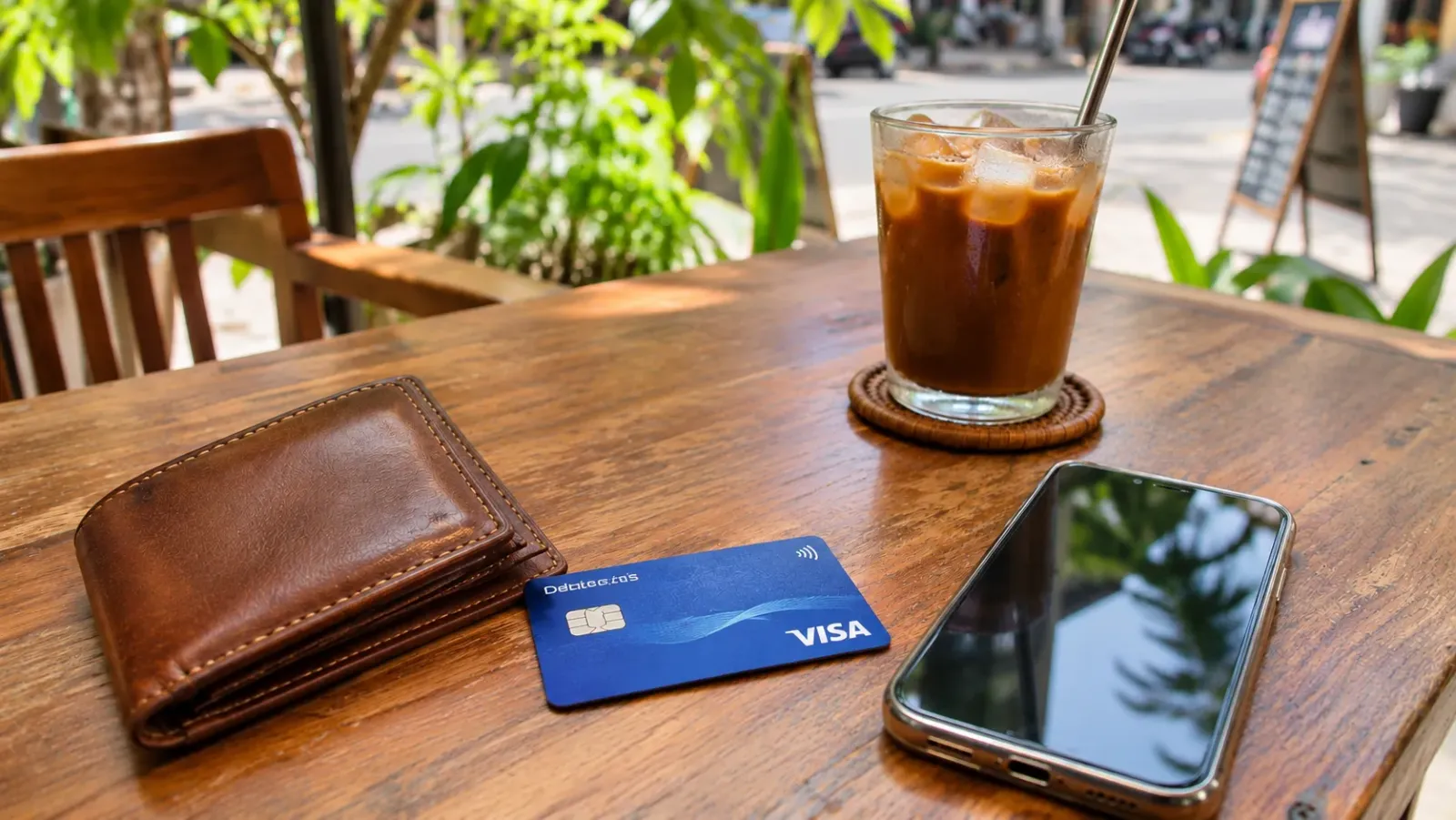
Most visitors get by with three things: some dong in cash, a bank card or two and a phone.
What to Pay With, and Where
Think of Vietnam as two payment worlds that sit side by side. The table shows which one you are standing in.
| Where you are paying | Cash (dong) | Foreign card | QR code |
|---|---|---|---|
| Hotels, malls, supermarkets, chain cafés | Accepted | Usually accepted | Common, if your app is linked |
| Mid-range and upscale restaurants | Accepted | Often accepted; check the total before paying | Common, if your app is linked |
| Street food, local markets, small shops | Best option | Rarely | Often displayed, but usually for local bank apps |
| Ticket counters at major sights | Accepted; a sensible backup | Increasingly accepted | Increasingly accepted |
| Islands, boats, villages and roadside stops | Often the only option | Do not count on it | Do not count on it |
| Ride-hailing apps | Accepted | Reported to work when linked in the app | Not needed |
The pattern is simple: the bigger and newer the business, the more ways you can pay. The smaller and more local it is, the more you will want small notes in your pocket.
The Vietnamese Dong: Notes, Zeros and Look-Alikes
The Notes You Will Actually Use
The State Bank of Vietnam is the only issuer of the dong. Its currency pages list six polymer notes: 10,000, 20,000, 50,000, 100,000, 200,000 and 500,000 dong. These plastic notes are the ones you will handle every day. Below them sit small paper notes of 1,000, 2,000 and 5,000 dong, which you will receive as change.
Coins are still legal tender on paper, but you are unlikely to see one during an ordinary trip. In January 2026 the State Bank also dismissed online rumours that it planned to withdraw the smallest notes, so the 1,000 to 5,000 dong notes remain valid.
The classic mistake is paying with the wrong blue note. The 500,000-dong note and the 20,000-dong note are both blue-toned and easy to confuse in dim light or in a hurry, yet one is worth 25 times the other. Keep large notes in a separate section of your wallet and read the number before you hand anything over.
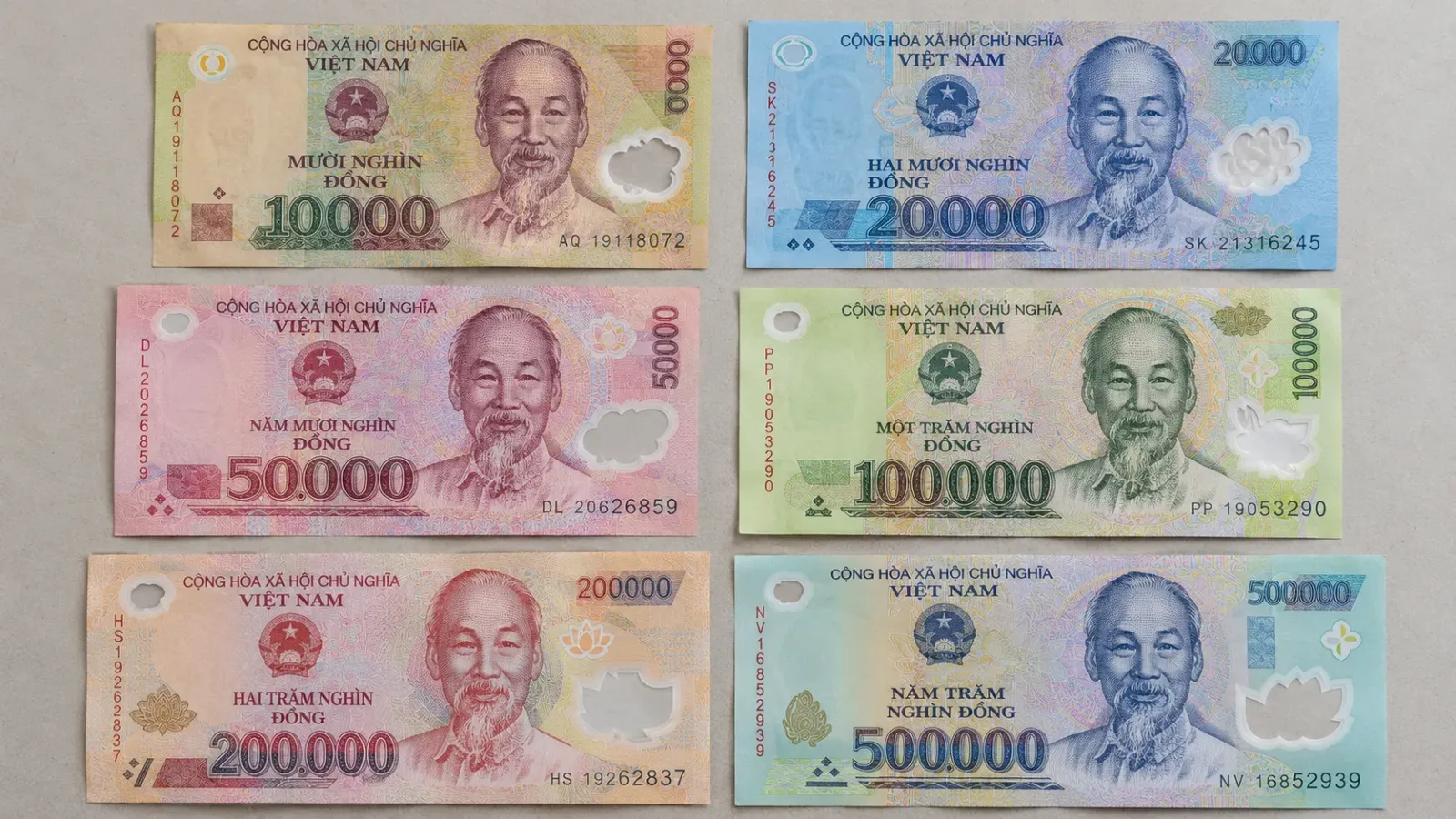
Read the number, not the colour: the 20,000 and 500,000 dong notes are both blue-toned.
Reading Prices: Thousands and "K"
Because every price runs into the thousands, Vietnamese menus and price tags often shorten them. "50K" means 50,000 dong, and a stallholder who says "fifty" almost always means the same thing. If a price sounds impossibly cheap or alarmingly high, ask the seller to type it into a phone calculator.
For a quick conversion from dong to US dollars, drop the last three zeros and divide by 26. A 260,000-dong dinner is about US$10; a 500,000-dong note is about US$19. On 23 November 2026 the State Bank's reference rate was 25,668 dong to the dollar. Commercial banks that morning were buying US dollars at about 25,600 and selling at about 26,000. Banks usually quote a slightly lower buying rate for banknotes than for transfers, so the rate you get for cash at a counter can differ a little from the posted figures.
Can You Pay in US Dollars?
As a rule, no. State Bank regulations require prices, quotes and payments inside Vietnam to be in dong, apart from a short list of permitted cases, and the central bank confirmed on 10 November 2026 that these rules remain in force. If a shop or driver quotes you a price in dollars, ask for the dong price and pay that.
You may still see foreign-currency amounts online. Vietnamese rules allow airlines, hotels and tourism businesses to show a foreign-currency equivalent alongside prices in dong under specific conditions. A foreign-currency amount on a website does not by itself mean that you can pay in that currency inside Vietnam, so check the final booking currency and payment terms before you confirm. For bookings on this site, our payment options page explains how payments work.
Changing Money Legally
Banks and Licensed Exchange Counters
You can change foreign cash into dong at banks and at exchange agents authorised by a bank. Authorised agents include counters at international airports, many hotels and some jewellery shops that hold a licence. A licensed counter displays a sign naming the bank that authorises it, and it will give you a receipt if you ask.
The UK government's travel advice for Vietnam makes the same point: change money only at official counters with a clear sign showing that status. Bring clean, undamaged notes, because torn or heavily marked bills are often refused.
What the 2026 Rules Mean for Visitors
For years, travellers swapped dollars at gold shops without thinking about whether the shop was licensed. That is now a real risk. Decree 340/2025, in force since 9 February 2026, sets penalties for the customer as well as the business:
- Buying or selling foreign currency at an unlicensed place: a warning if the amount is under US$1,000.
- From US$1,000 to under US$10,000, or a repeat offence below US$1,000: a fine of 10 to 20 million dong.
- Larger amounts bring higher fines.
Vietnamese state media reported the new scale when the decree was issued. The practical advice is short: if you cannot see a bank's authorisation sign, change your money somewhere else. A slightly better rate is not worth the risk.
Using ATMs in Vietnam
For most visitors an ATM is the simplest way to get dong. Machines are easy to find in cities and tourist towns, and they generally accept Visa and Mastercard. They become scarce on small islands and in mountain villages, so withdraw before you leave town.
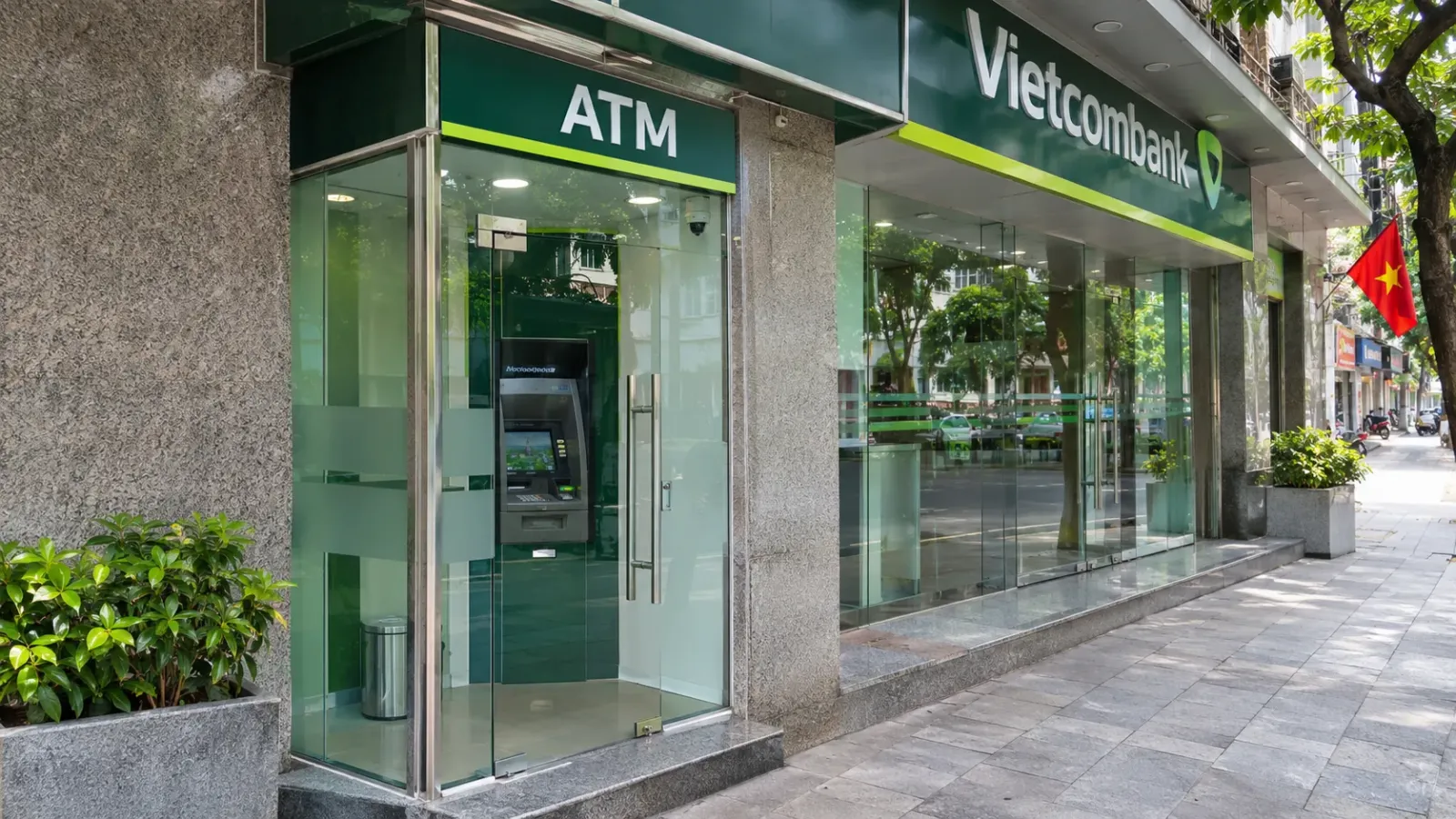
Machines attached to a bank branch are the safest choice if a card is retained.
Fees and Withdrawal Limits
Expect two separate charges. The Vietnamese bank that owns the machine usually adds its own fee for foreign cards, and your bank at home may add a foreign-withdrawal fee and a currency margin on top.
There is no single nationwide fee for foreign cards. Both the fee and the limit depend on the bank, the machine and your card:
- Local fee: the ATM operator may charge a flat fee or a percentage, depending on the bank and card network.
- Withdrawal limit: the maximum amount varies by ATM, bank and card. A machine may set a lower per-transaction limit than your home bank allows.
Check whether the ATM displays an operator fee before you confirm; if it seems high, you can cancel and try another bank. Review your bank statement afterwards for any further charges from your card issuer. Because the fee is usually charged per withdrawal, taking out a larger amount less often costs less than making many small withdrawals. Ask your own bank what it charges for withdrawals abroad before you travel.
Always Choose to Be Charged in Dong
Some ATMs and card terminals offer to convert the transaction into your home currency on the spot. Decline, and choose dong. The on-the-spot conversion uses a rate set by the machine's operator, and it is almost always worse than the rate your own bank would give you.
If a Machine Fails or Keeps Your Card
The US State Department notes in its Vietnam travel information that ATMs can be out of order and may charge high fees. Plan for that:
- Carry two cards from different banks or networks, and keep them in separate places.
- Use machines attached to a bank branch during opening hours when you can, so staff can help if a card is retained.
- Tell your bank you are travelling, and check your daily withdrawal limit before you fly.
- Keep your bank's emergency number somewhere other than your phone. If a card is lost, stolen or kept by a machine, freeze it in your banking app and call your bank straight away.
- Travelling over the Lunar New Year? Machines in quieter areas can run low, so read the banking section of our Tet travel guide first.
Paying by Card
Visa and Mastercard are the safest cards to bring; other networks are accepted in fewer places. You can expect to pay by card at hotels, shopping centres, supermarkets, chain cafés, airline counters and many restaurants aimed at visitors. Contactless payment, including a card stored on your phone, works wherever the terminal supports it, which in practice means newer businesses in the big cities.
Three habits will save you money:
- Question any extra card-payment fee. Some travellers report businesses asking for a surcharge when they pay by card, but merchants in Vietnam are generally not permitted to charge extra simply because you choose a cashless payment. Ask for the price before paying, and distinguish a merchant's proposed surcharge from the foreign-transaction fee your own bank may charge.
- Pay in dong, not your home currency, for the same reason as at ATMs.
- Check the amount on the terminal. With so many zeros, a slip of the finger can turn 150,000 into 1,500,000.
Major sights are moving the same way. In Hue, the conservation centre encourages cashless payment at its ticket counters, as our Hue Imperial City ticket guide explains, and Hoi An now has self-service kiosks that accept international payment, covered in our Hoi An Ancient Town ticket guide. Both guides still suggest carrying some cash in case a terminal is down.
QR Payments: Who Can Scan and Who Cannot
You will see a printed QR code on almost every counter in Vietnam, from department stores to noodle carts. Local people scan it with a banking app and the money moves between Vietnamese bank accounts in seconds. Two systems share that look. The everyday VietQR code is a domestic bank transfer, while VietQRGlobal is the cross-border version built for foreign apps. Whether you can pay depends on where your payment app comes from and which code the merchant shows.
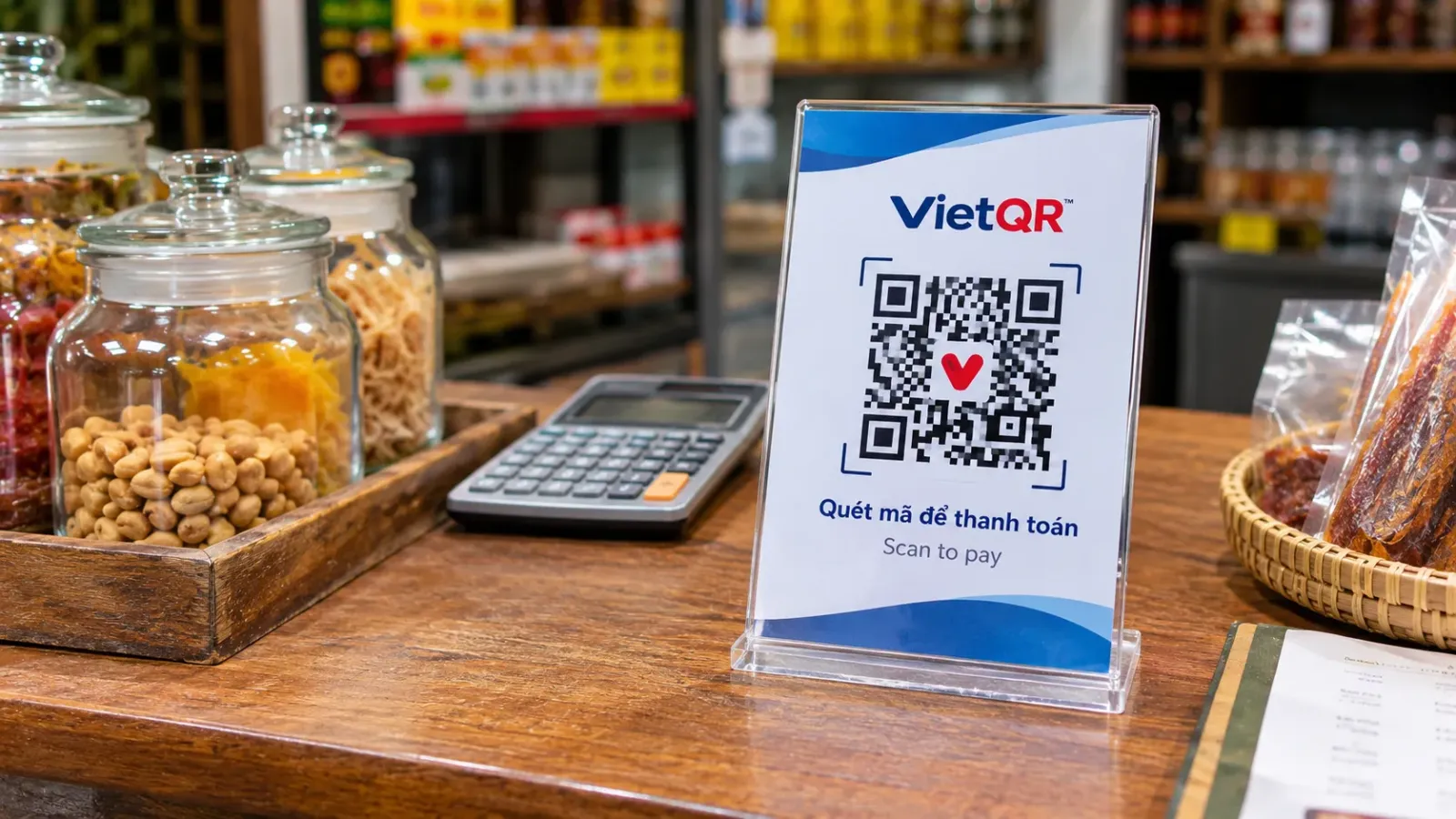
A QR stand sits on almost every counter, but only some codes work with foreign payment apps.
Visitors From the Six Linked Markets
Vietnam's national payment network, NAPAS, runs a cross-border service called VietQRGlobal. As of November 2026 it links Vietnam with six markets: China, South Korea, Thailand, Laos, Cambodia and Singapore. If you bank in one of them, a participating app from home can scan a VietQRGlobal code, show you the price in your own currency and pay the merchant in dong.
The network grew quickly in 2026. Chinese visitors have been able to pay with Alipay since April, and the link with Singapore opened on 2 July. According to Vietnamese state media, acceptance is spreading from hotels and shopping centres to markets, restaurants and souvenir stalls.
Two cautions apply. Not every app in a linked country takes part, and not every QR code you see is a VietQRGlobal code. Check with your bank or wallet provider before you travel, and look for the VietQRGlobal mark at the till.
Everyone Else
If your bank is in Europe, North America, Australia or anywhere else outside those six markets, assume that your banking app cannot scan a Vietnamese QR code. The standard code is an instruction for a transfer between Vietnamese bank accounts, not a card payment. Local e-wallets are a poor workaround for a short visit, because they are generally built around a Vietnamese phone number and bank account.
More links are planned. Taiwan, India and Japan were mentioned in plans for 2026, but none had a confirmed launch date at the time of writing, so treat them as proposals rather than services you can use. Until your country is connected, a card for larger bills and cash for small ones is the dependable combination.
How Much Cash to Carry
There is no single right figure, because it depends on where you are going rather than how long you are staying. A better approach is to match your cash to the day ahead.
- City days: you can pay for most things by card, so carry enough small notes for street food, markets, short taxi rides and tips.
- Markets and boat trips: sellers deal in cash and small change. At Can Tho's floating market, for example, food boats and fruit sellers expect notes, as our Cai Rang floating market guide describes.
- Islands and remote areas: take what you need for the whole visit. On the Cham Islands, card payment is not something to rely on.
- Sightseeing stops: smaller entrance fees, lifts and lockers are often cash only, even when the main ticket office takes cards.
- Guided tours: check what your tour includes. Extra drinks, optional activities and tips are normally paid on the day.
Ask for small notes whenever you can. A street vendor selling a 30,000-dong coffee may not be able to change a 500,000-dong note first thing in the morning. Break large notes at supermarkets, convenience stores and hotels, and keep the small ones for the street.
Bringing Cash In and Out of Vietnam
You may bring cash into Vietnam, but you must declare it to customs on arrival if you carry more than US$5,000, or the equivalent in another foreign currency, or more than 15 million dong. The same thresholds apply when you leave. Bank cards do not count towards these limits.
If you depart Vietnam with cash above the declaration thresholds, you must present the applicable supporting documents to customs. If you are taking out no more than the amount you declared on your most recent arrival, your customs-certified arrival declaration can serve as proof for your next departure within 12 months. In other cases, a confirmation from an authorised credit institution or written approval from the State Bank of Vietnam may be required. The rules are set out in State Bank Circular 15/2011 (in Vietnamese); check them before you travel.
The cash rule sits alongside the passport, visa and pre-arrival steps in our Vietnam visa and entry requirements guide.
Tipping in Vietnam
Tipping is not a traditional part of everyday life in Vietnam, and no one is obliged to tip. In tourism, though, it has become a common way to thank guides, drivers and boat crews, whose basic pay is often modest. Treat it as a reward for good service, give it in dong, and hand it to the person directly.
The amounts below are customs commonly described in travel guidance, not rules. Adjust them to the service you received and to your own budget.
| Situation | What is customary |
|---|---|
| Street food, local cafés, market stalls | No tip expected |
| Restaurant with a service charge on the bill | No further tip needed |
| Restaurant without a service charge | Optional; around 5 to 10 per cent for a good meal |
| Taxis and ride-hailing | Not expected; rounding up the fare is a kind gesture |
| Hotel porters and housekeeping | Optional; a small note is appreciated |
| Tour guides, drivers and boat crews | Customary on organised tours if you were happy with the day |
| Boat rowers at sights such as Tam Coc | Optional; a small tip if you enjoyed the ride |
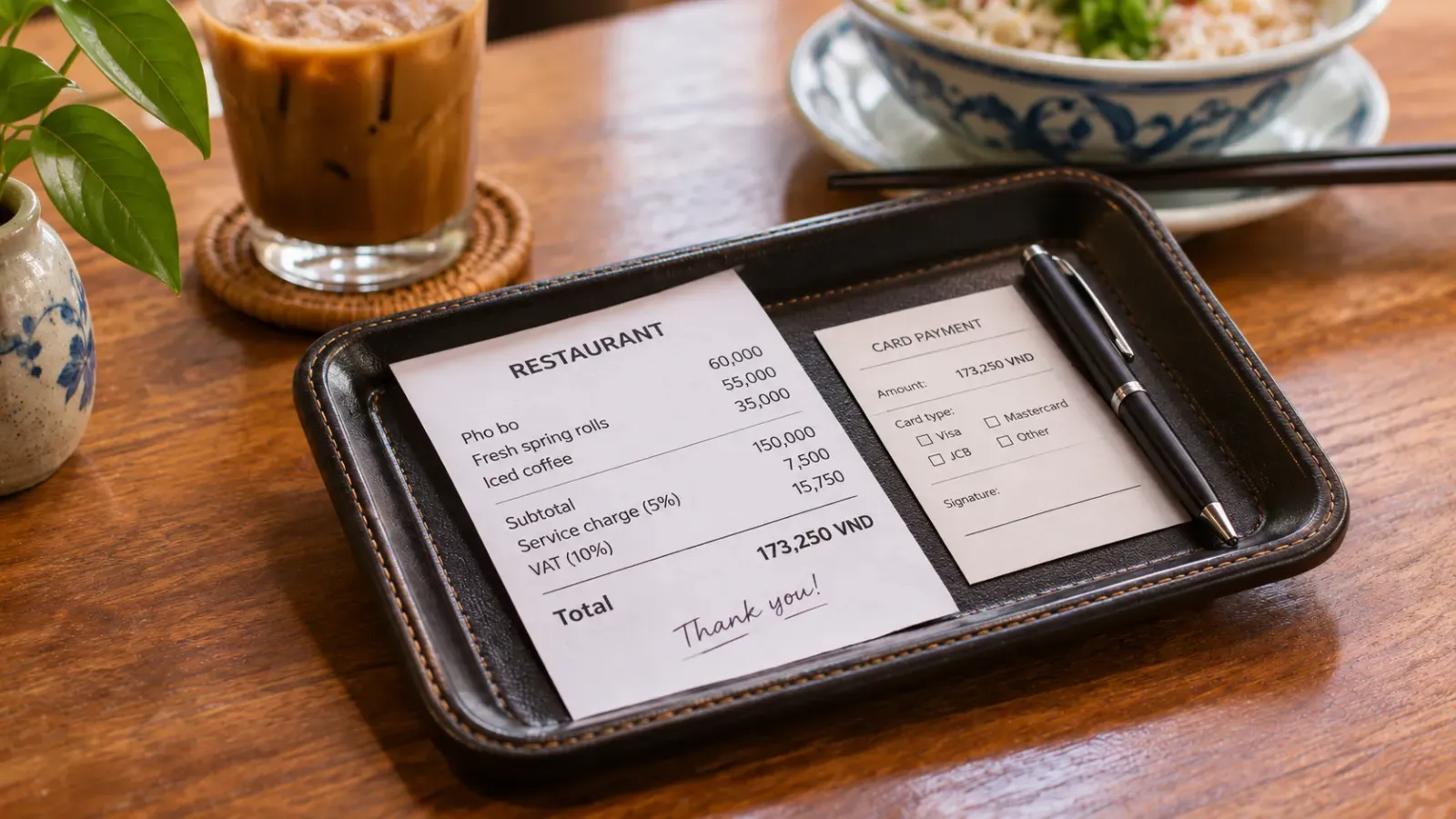
Check the receipt for a service charge before deciding whether to leave anything extra.
Service Charges on the Bill
Some restaurants and hotels add a service charge, typically 5 per cent, to the bill. Check the last lines of the receipt before you decide whether to leave anything extra. If a service charge is already there, you have no need to add a tip. Value-added tax (VAT) may appear as its own line on the same receipt; it is a tax, not a service charge.
Guides, Drivers and Boat Crews
Tips are often not included in a tour price. Many of our tour pages list tips and gratuities under what is not included, so check the inclusions and exclusions for the tour you select; any tip is your decision on the day. There is no fixed amount. If you would like a starting point, ask your guide's company in advance or simply give what feels fair for the length of the day and the size of your group.
You may also meet requests for tips at busy sights. At Tam Coc, some rowers suggest buying from vendor boats or ask for a tip near the end of the ride. A polite "no, thank you" is perfectly acceptable; our Tam Coc vs Trang An guide explains what to expect.
Common Money Mistakes and How to Stay Safe
| Mistake | How to avoid it |
|---|---|
| Handing over a 500,000-dong note instead of a 20,000 | Keep large notes apart and read the number, not the colour |
| Changing money at an unlicensed shop | Use a bank or a counter showing a bank's authorisation sign |
| Accepting conversion to your home currency | Choose dong at ATMs and card terminals |
| Making many small ATM withdrawals | Withdraw larger amounts less often, within what you are comfortable carrying |
| Relying on one card | Carry a second card and some reserve cash, stored separately |
| Agreeing a price in dollars | Ask for the price in dong and confirm it on a calculator |
Ordinary street sense covers the rest. Use ATMs in well-lit, busy places, shield the keypad and put your cash away before you walk off. Canada's travel advice for Vietnam warns about credit-card and ATM fraud and advises visitors to use official taxis or trusted ride-hailing apps. Arrange airport transport through an official taxi counter, your hotel or a reputable app, and check the vehicle and driver before getting in. Count your change at the counter, and keep the bulk of your cash and your spare card in the hotel safe.
Frequently Asked Questions
Is Vietnam a cash or a card country?
Both. Cards cover hotels, malls, supermarkets and many restaurants in the cities. Cash covers street food, markets, small shops and most places outside the main tourist centres. Bring a card and plan to carry some dong every day.
Can I pay in US dollars in Vietnam?
Generally not. Prices and payments inside Vietnam must be in dong, with limited exceptions. Change your dollars at a bank or licensed counter and pay in dong.
Should I buy dong before I travel?
You do not need to. You can withdraw dong from an ATM or change major currencies at a licensed counter when you arrive, including at international airports.
Can tourists pay by QR code in Vietnam?
Sometimes. You need a participating payment app from China, South Korea, Thailand, Laos, Cambodia or Singapore, and the merchant must display a VietQRGlobal code. An ordinary domestic VietQR code will not work with a foreign app. Visitors from other countries should plan on cards and cash for now.
Do Vietnamese ATMs accept foreign cards?
Most do, particularly Visa and Mastercard. Expect a local fee and a limit on each withdrawal; both vary by bank.
How much cash can I bring into Vietnam?
There is no ban on bringing more, but you must declare cash above US$5,000, or the equivalent in another foreign currency, or above 15 million dong.
Is tipping expected in Vietnam?
No. It is optional. It is customary to tip guides, drivers and boat crews on organised tours when the service was good, and unnecessary where a service charge is already on the bill.
Plan Your Trip
With your money sorted, the rest of the planning gets simpler. Our two-week Vietnam itinerary shows how to connect the north, centre and south, and the month-by-month guide to the best time to visit helps you choose your dates. If you would rather have a route built around your own plans, start with a customised tour, and for any question about a booking, contact our team.
Related articles

Vietnam Visa & Entry Requirements 2026–27: Visa-Free Entry, E-Visas and What to Expect on Arrival

Vietnam’s 2025 Province Mergers: Old and New Place Names and What They Mean for Your Trip

Water Puppet Shows in Hanoi vs Saigon: Where to Watch and How to Choose

Best Time to Visit Vietnam: A Month-by-Month Guide to the North, Centre and South
Central Vietnam Flood & Typhoon Season: When It Happens and How to Plan Your Trip

Tet 2027 in Vietnam: Dates, What's Open and How to Plan Your Trip

Hoi An at Night: Lanterns, River Boats, the Night Market and Where to Go After Dark